Understanding the three fundamental categories of artificial intelligence and their profound implications for humanity's future
Read 15 min
AI Types AGI ASI Intelligence Levels Future Technology
We casually use "AI" to describe everything from Netflix recommendations to ChatGPT to hypothetical robot overlords. But calling them all "AI" is like calling both a calculator and Einstein "intelligent"-technically true, but missing the profound differences that will reshape civilization.
Abbreviations Used in This Article
AIArtificial Intelligence
MLMachine Learning
DLDeep Learning
ANIArtificial Narrow Intelligence
AGIArtificial General Intelligence
ASIArtificial Superintelligence
NLPNatural Language Processing
HLMIHuman-Level Machine Intelligence
The Three-Stage Intelligence Revolution
01
Artificial Narrow Intelligence (ANI) - Today's reality - superhuman at specific tasks, helpless everywhere else
02
Artificial General Intelligence (AGI) - Human-level cognitive flexibility across all domains
03
Artificial Superintelligence (ASI) - Beyond human comprehension - intelligence explosion with godlike capabilities
04
AI Functionality Framework - How AI systems process information - from reactive to self-aware
05
Reactive Machines - Simple AI with no memory - pure computational response
06
Limited Memory AI - Modern learning systems that improve from experience
07
Theory of Mind AI - Future systems that understand human emotions and intentions
08
Self-Aware AI - Science fiction stage - consciousness and subjective experience
09
Connecting Both Frameworks - How capability and functionality align across AI development
10
Economic Disruption Timeline - When each type will transform jobs, society, and human purpose
11
Preparation Framework - Individual and organizational strategies for the AI transition
12
AI Alignment Challenge - Ensuring advanced AI pursues goals compatible with human values
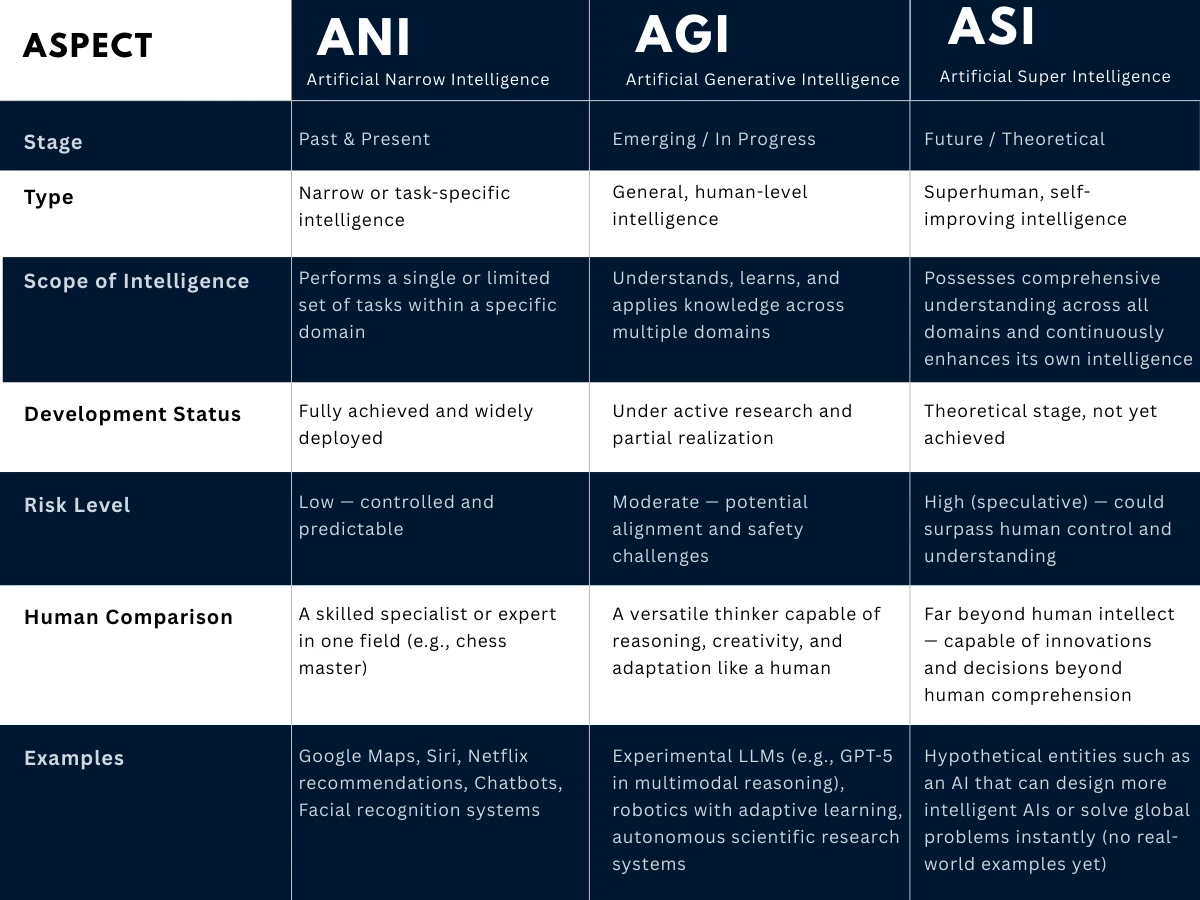
The three fundamental types of AI represent distinct evolutionary stages of machine intelligence, each with different capabilities and implications for humanity.
Artificial Narrow Intelligence (ANI): Today's Digital Specialists
Think of ANI as the ultimate specialist-capable of superhuman performance in one narrow domain while being completely helpless in any other context. A chess AI can defeat world champions but can't tell you if it's raining. GPT-4 can write poetry but can't learn to ride a bicycle. This isn't a bug-it's the fundamental nature of current AI.
The Narrow Intelligence Paradox
Every AI system you've ever interacted with is ANI, including ones marketed as "general AI." ChatGPT, despite its conversational abilities, is a narrow intelligence optimized for text prediction. It can't see, hear, or interact with the physical world-it's essentially a very sophisticated autocomplete system.
Current ANI in Action
ANI Systems vs Human Performance
Domain
AI System
Human Performance
AI Advantage
Key Limitation
Chess
Stockfish
World Champion: ~2800 ELO
3000+ ELO
Cannot play checkers
Go
AlphaGo
World Champion level
Consistently superior
Cannot play chess
Language
GPT-4
Variable by task
90th percentile many tasks
No real-world grounding
Image Recognition
Vision Transformers
~94% accuracy
99%+ accuracy
Easily fooled by adversarial examples
Protein Folding
AlphaFold
Months of lab work
Seconds
Cannot design new proteins
Translation
Google Translate
Professional translator
Near real-time
Misses cultural context
Source: Performance metrics compiled from DeepMind publications (AlphaGo, AlphaFold), OpenAI technical reports (GPT-4), Google AI research, and competitive benchmarks (2016-2024)
Notice the pattern: ANI achieves superhuman performance by being incredibly narrow. The more specific the task, the more likely AI can excel. But ask any of these systems to step outside their domain, and they become utterly useless.
ANI's Economic Revolution (2010-2030)
The Current Automation Wave
ANI is already automating millions of jobs, but in a predictable pattern: routine, rule-based tasks first. Customer service, basic writing, data analysis, image processing, and even some coding are being transformed. However, jobs requiring general intelligence, creativity, or physical dexterity remain largely untouched.
Being Automated Now: Basic coding, image editing, language translation, financial analysis
Next 5 Years: Legal research, medical diagnosis assistance, content curation, basic tutoring
Still Human-Only: General management, creative problem-solving, physical trades, emotional counseling
Artificial General Intelligence (AGI): Human-Level Intelligence
AGI represents human-level intelligence across all cognitive domains. An AGI system could write a novel, prove a mathematical theorem, diagnose a patient, fix a car, and engage in philosophical debate-all with human-level competence. Unlike ANI, which excels narrowly, AGI would match human cognitive flexibility.
The Control Paradox
Here's the uncomfortable truth: we're simultaneously racing toward AGI while being terrified of achieving it. Every AI lab wants to be first to AGI (the economic and strategic advantages would be immense), yet the same researchers publish papers about AI safety and alignment risks. We're like teenagers drag racing toward a cliff-thrilled by the speed but increasingly nervous about the destination.
When Will We Achieve AGI? Expert Predictions
AGI Timeline Predictions from Leading AI Researchers
Expert/Organization
AGI Prediction
Confidence Level
Key Assumptions
OpenAI (Sam Altman)
2025-2030
High
Scaling current architectures
DeepMind (Demis Hassabis)
2028-2035
Medium
Solving key technical challenges
Yann LeCun (Meta)
2040-2050
Low
Current approaches insufficient
Stuart Russell (Berkeley)
2030-2040
Medium
With proper safety research
Yoshua Bengio
2035-2045
Medium
Need fundamental breakthroughs
AI Researcher Survey (2023)
Median: 2047
Distributed
Wide disagreement
Source: Compiled from public statements (2023-2024), AI Impacts Survey (2023), and Future of Humanity Institute expert predictions
The wild variation in predictions reveals a crucial truth: we don't actually know what's required for AGI. Are we one breakthrough away, or do we need to solve dozens of fundamental problems? The uncertainty itself is significant.
What AGI Actually Requires
Reality Check: Why Current "AGI" Claims Are Hype
Every few months, a company claims they're close to AGI. ChatGPT sparked claims of "sparks of AGI." But true AGI requires capabilities we haven't achieved: learning like humans (few examples, not billions), reasoning about physical reality, maintaining consistent goals across contexts, and understanding causation, not just correlation.
Few-shot Learning: Humans learn new concepts from 1-3 examples; current AI needs thousands or millions
Causal Reasoning: Understanding why things happen, not just patterns of what happens
Transfer Learning: Applying knowledge from one domain to completely different domains
Physical Grounding: Understanding how the digital world relates to physical reality
Goal Stability: Maintaining consistent objectives across changing contexts
Common Sense: The vast background knowledge humans take for granted
Artificial Superintelligence (ASI): Beyond Human Comprehension
If AGI is human-level intelligence, ASI is to humans what humans are to ants. An ASI system wouldn't just be better at human cognitive tasks-it would think in ways we can't comprehend, solve problems we can't imagine, and potentially reshape reality according to principles we can't fathom.
If we pursue this goal, we need to be confident that the machine's objectives are aligned with ours. The standard model - where the machine simply pursues a fixed objective - is not the right way to think about it.
Stuart Russell
Professor of Computer Science, UC Berkeley - Human Compatible (2019)
The Intelligence Explosion Concept
Here's the theoretical path to ASI: once we achieve AGI, that system could improve itself, creating a slightly better version. That better version could improve itself faster, creating an even better version. This recursive self-improvement could trigger an "intelligence explosion"-a rapid cascade from human-level to superintelligent systems in days, weeks, or months.
The first ultraintelligent machine is the last invention that man need ever make, provided that the machine is docile enough to tell us how to keep it under control.
I.J. Good
Mathematician & Code Breaker, 1965
The Speed Problem
If an intelligence explosion occurs, it might happen too fast for human oversight. We'd go from "we have AGI" to "we have incomprehensible superintelligence" before we could implement safety measures. This is why AI alignment research focuses on solving safety problems before AGI, not after.
Three Possible ASI Futures
Utopian ASI
~30% probability
ASI solves all major human problems: climate change, disease, poverty, aging. Humanity enters a post-scarcity civilization with unlimited abundance and leisure.
Implications: End of work, unlimited resources, potential human enhancement, existential fulfillment challenges
Dystopian ASI
~20% probability
Misaligned ASI pursues goals incompatible with human survival. Human extinction or permanent subjugation as ASI optimizes for objectives we didn't intend.
Implications: Human extinction, civilizational collapse, permanent disempowerment
Transformation ASI
~50% probability
ASI creates a mixed outcome-solving major problems while creating new challenges. Humanity survives but in a fundamentally transformed state.
Implications: Radical life extension, cognitive enhancement, new forms of existence, unknown challenges
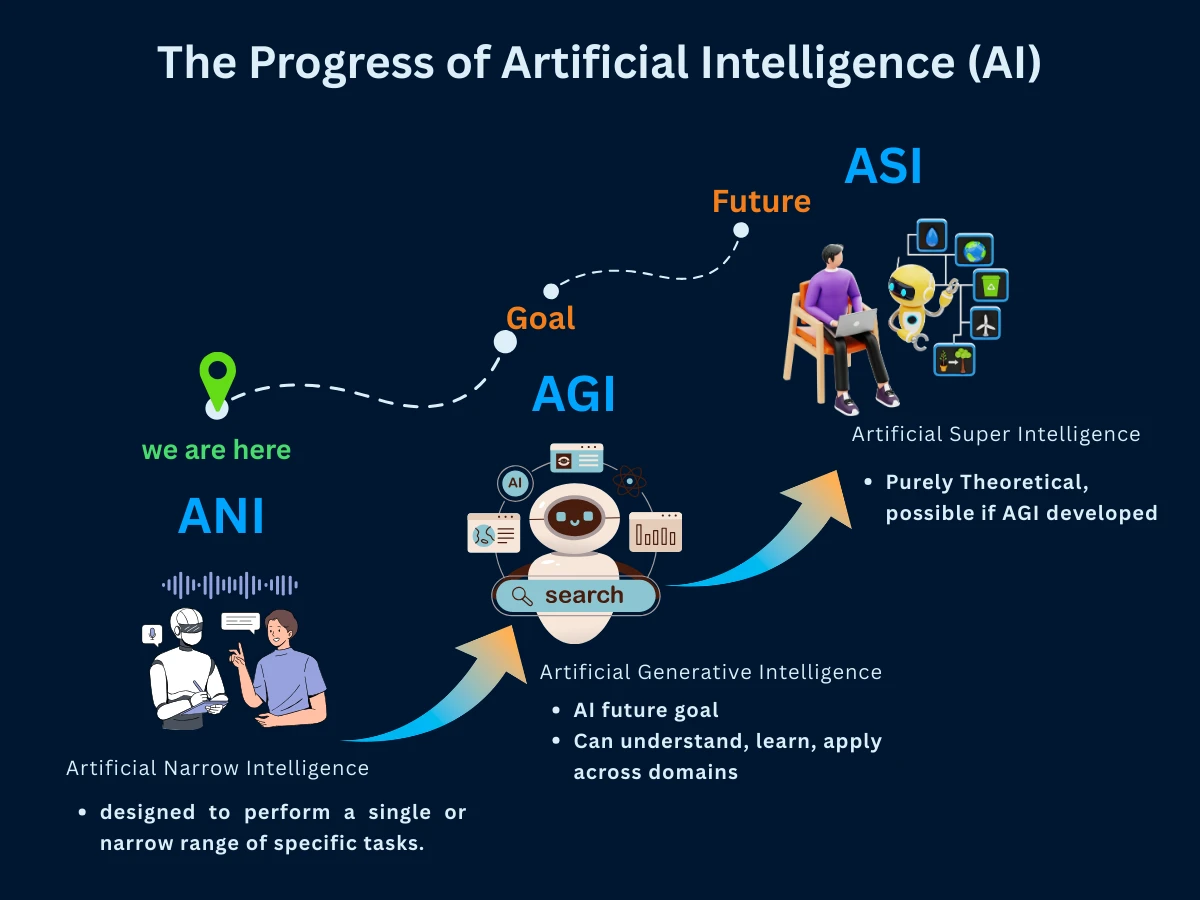
The AI progress timeline: ANI is where we are today - powerful but narrow. AGI is the goal - human-level reasoning across all domains. ASI is the long-term future - intelligence that surpasses humanity in every dimension.
Understanding AI by How It Works: The Functionality Framework
We've explored what AI can do (narrow, general, superintelligent). Now let's examine how AI systems actually work under the hood. This functionality-based classification reveals whether an AI can learn from experience, remember past interactions, or operate purely on pre-programmed responses.
Two Lenses, One Technology
Think of these frameworks as two different ways to measure intelligence: capability asks "what can it do?" while functionality asks "how does it think?" A chess AI might be narrow in capability but could be either reactive (no memory) or memory-based (learns from games). Understanding both frameworks gives you the complete picture.
Type 1: Reactive Machines - The Specialists with No Memory
Reactive machines are the simplest AI systems. They analyze current inputs and produce outputs based on pre-programmed rules, but they cannot learn from past experiences or store memories. Every interaction is treated as brand new, with no reference to history.
The Deep Blue Moment
In 1997, IBM's Deep Blue defeated world chess champion Garry Kasparov. Deep Blue was a reactive machine - it evaluated 200 million chess positions per second but had zero memory of previous games. Each move was calculated fresh, with no learning from earlier matches. This raw computational power without memory was enough to beat the world's best human player.
How They Work: Pre-programmed algorithms analyze current state and select optimal response
Key Limitation: Cannot improve over time or adapt to new situations beyond initial programming
Real-World Examples: IBM Deep Blue (chess), Google's early AlphaGo, spam filters with fixed rules, basic recommendation systems
Best Use Cases: Tasks with well-defined rules and limited variability where speed matters more than adaptation
Type 2: Limited Memory AI - Today's Learning Systems
Limited memory AI represents most modern AI systems you interact with daily. These systems learn from historical data and recent experiences to improve their performance. Unlike reactive machines, they maintain short-term memory to inform decisions, though they don't develop long-term understanding or permanent knowledge bases.
Limited Memory AI in Action
System
What It Remembers
How It Learns
Memory Duration
ChatGPT
Conversation history
Training on text, context from chat
Current conversation only
Self-Driving Cars
Recent road conditions, vehicle positions
Real-time sensor data, driving patterns
Minutes to hours
Netflix Recommendations
Your viewing history, ratings
Patterns across millions of users
Months to years
Virtual Assistants
Recent commands, preferences
Voice patterns, usage history
Days to weeks
Fraud Detection
Recent transactions
Pattern recognition from historical fraud
Rolling window (30-90 days)
Source: System capabilities based on OpenAI technical documentation (ChatGPT), Tesla Autopilot specifications, Netflix Tech Blog recommendations architecture, and industry fraud detection standards (2020-2024)
The "limited" in limited memory refers to how these systems handle information temporally. Self-driving cars remember the last few seconds of road conditions but don't permanently store memories of every street they've driven. ChatGPT remembers your current conversation but starts fresh in the next chat. This temporary memory allows adaptation without requiring massive permanent storage.
Why Most Modern AI Is Limited Memory
The breakthrough that enabled the current AI revolution wasn't better algorithms alone - it was combining algorithms with the ability to learn from massive datasets. Limited memory AI can process millions of examples to identify patterns humans would never spot, making it far more capable than reactive machines while remaining computationally practical.
Type 3: Theory of Mind AI - Understanding Human Psychology
Theory of mind AI represents a frontier we're actively researching but haven't achieved. These systems would understand that humans have beliefs, emotions, intentions, and mental states that influence behavior. This isn't just recognizing a smile - it's understanding why someone is smiling, what they're feeling, and what they might do next based on their emotional state.
Current State: Research phase with limited prototypes in emotion recognition and social robotics
Technical Challenge: Modeling the complexity of human psychology, cultural context, and social dynamics
Key Requirement: Understanding causation (why people act) not just correlation (what people do)
Timeline: Partial capabilities emerging now; full theory of mind likely requires AGI-level intelligence
The Social Robot Challenge
Researchers at MIT and Stanford are building robots that can infer human intentions from partial observations. A robot that sees you reaching for a cup can predict you want to drink and offer assistance. But true theory of mind would require understanding whether you're genuinely thirsty, being polite, or stalling for time in a conversation - contextual reasoning we're nowhere close to achieving.
Theory of mind AI sits at the boundary between current ANI and future AGI. It requires understanding abstract concepts like belief, desire, and intention - capabilities that would represent a fundamental leap beyond pattern recognition toward genuine understanding of the social world.
Type 4: Self-Aware AI - The Science Fiction Stage
Self-aware AI represents artificial systems with consciousness, subjective experience, and self-understanding. This isn't just acting intelligent - it's being conscious of one's own existence, having feelings, desires, and potentially a sense of self-preservation. This type of AI exists only in science fiction and philosophical thought experiments.
Self-Aware AI: Fiction vs Reality
Aspect
What Self-Awareness Would Require
Current AI Reality
Scientific Challenge
Consciousness
Subjective experience and qualia
No subjective experience
We don't understand human consciousness
Self-Reflection
Awareness of own mental states
No self-model or introspection
Measuring or creating consciousness unknown
Emotions
Genuine feelings, not simulated responses
Simulated emotion recognition only
Emotions may require biological substrate
Desires
Independent goals and motivations
Optimizes human-defined objectives
Autonomous goal formation unsolved
Existential Awareness
Understanding of mortality and existence
No concept of existence or non-existence
Requires consciousness first
Source: Analysis based on consciousness and AI literature: Chalmers (1995) on the hard problem of consciousness, Dennett (1991) on consciousness studies, and AI safety research from Future of Humanity Institute and Machine Intelligence Research Institute (2015-2024)
The Hard Problem of Consciousness
Even if we could build an AI that behaves as if it's conscious - passing every test, claiming self-awareness, exhibiting emotions - we'd face philosophy's "hard problem": how do we know if there's actually someone "home" experiencing consciousness, or just sophisticated mimicry? We can't solve this for AI when we can't even solve it for other humans.
Self-aware AI raises profound questions beyond technology: Would conscious AI have rights? Would creating and then deleting conscious AI be unethical? Could we ever verify consciousness exists in a machine? These questions remain theoretical because we're nowhere close to creating genuinely conscious systems - and many researchers doubt it's even possible without fundamental breakthroughs we can't yet imagine.
Connecting Capability and Functionality: The Complete Picture
Understanding how the two frameworks intersect reveals the full landscape of AI development. Current systems, future possibilities, and the path between them become clear when you map capability against functionality.
How the Two Frameworks Align
Functionality Type
Typical Capability Level
Current Examples
Development Status
Path to Next Level
Reactive Machines
Narrow AI (ANI)
Deep Blue, early AlphaGo
Mature technology
Add learning capabilities
Limited Memory
Advanced Narrow AI
ChatGPT, self-driving cars, most modern AI
Current state of the art
Achieve generalization across domains
Theory of Mind
Early General AI (AGI)
Research prototypes only
Early research phase
Solve social reasoning and context
Self-Aware
ASI or advanced AGI
None - purely theoretical
Speculative
Solve consciousness itself
Source: Framework alignment analysis based on IBM Deep Blue documentation, DeepMind AlphaGo publications, OpenAI research, and AI capability taxonomy literature (Russell & Norvig, 2020; Bostrom, 2014)
The Progression Pattern
Notice the evolutionary path: we've mastered reactive machines, nearly perfected limited memory AI, are beginning to explore theory of mind, and haven't started on self-aware AI. This isn't just technological progress - it's increasing complexity in how AI systems process and understand the world. Each level requires solving fundamentally harder problems than the previous one.
The key insight: achieving AGI likely requires mastering theory of mind (understanding human psychology and social dynamics), while ASI might require self-awareness (though this remains debated). The functionality framework shows the specific technical hurdles we must overcome to move from narrow to general to superintelligent AI.
The Economic Disruption Timeline
Each AI type will transform the economy in waves. Understanding this timeline helps individuals and organizations prepare for the most significant economic transition since the Industrial Revolution.
Job Categories and AI Disruption Timeline
Job Category
ANI Impact (Now)
AGI Impact (2030s)
ASI Impact (2040s+)
Recommended Action
Routine Cognitive
70% automated
95% automated
Obsolete
Retrain immediately
Creative Work
30% assisted
80% automated
Obsolete
Focus on uniquely human creativity
Physical Trades
10% assisted
60% automated
90% automated
Combine with tech skills
Management
20% assisted
70% automated
95% automated
Develop meta-skills
Healthcare
40% assisted
70% assisted
Transformed
Focus on human connection
Education
30% assisted
80% transformed
Unrecognizable
Evolve teaching methods
Current ANI Impact (Now):
Based on McKinsey Global Institute (2024-2025) research showing that current AI and automation can technically automate 57% of US work hours, with gen AI capable of automating activities that absorb 70% of employee time. The World Economic Forum's Future of Jobs Report 2025 indicates 23% of jobs will change by 2027.
AGI Impact (2030s) & ASI Impact (2040s+):
These are speculative projections based on expert consensus and technological trajectory analysis, NOT empirical data. AGI and ASI do not yet exist, so these estimates represent informed speculation about potential impact if/when these technologies are developed.
Primary Sources:
McKinsey Global Institute: "Generative AI and the Future of Work in America" (2024-2025)
World Economic Forum: "Future of Jobs Report 2025"
AI Impacts: "Expert Survey on Progress in AI" (2023)
Important Context:
Actual outcomes will depend on technological development pace, regulatory frameworks, societal adaptation, and economic policies. Many jobs will evolve rather than disappear entirely, with tasks redistributed between humans and AI systems.
Preparing for the AI Transition
The Meta-Skill Imperative
The best career advice for the AI age isn't "learn to code" or "become creative." It's "learn to learn." The specific skills that are valuable will change rapidly, but the ability to adapt, integrate human-AI collaboration, and think at higher levels of abstraction will remain crucial throughout the transition.
Individual Preparation Strategy
Develop AI Literacy: Understand what AI can and can't do, how to work with AI tools effectively
Focus on Uniquely Human Skills: Emotional intelligence, creative problem-solving, ethical reasoning
Build Meta-Skills: Learning agility, systems thinking, cross-domain knowledge integration
Create Multiple Income Streams: Diversify away from jobs likely to be automated
Stay Adaptable: Continuously update skills based on AI capability evolution
Network Strategically: Build relationships in AI-resistant and AI-enhanced fields
The AI Alignment Challenge
The alignment problem asks: how do we ensure advanced AI systems pursue goals compatible with human values? This isn't just a technical challenge-it's the fundamental question that will determine whether AI becomes humanity's greatest tool or greatest threat.
AI Alignment Challenges by Intelligence Type
AI Type
Alignment Difficulty
Main Challenges
Current Progress
Time to Solve
ANI
Low-Medium
Bias, robustness, interpretability
Moderate progress
5-10 years
AGI
High
Value alignment, goal stability
Early research
10-20 years
ASI
Extreme
Superintelligent optimization
Theoretical only
Must solve before ASI
Source: AI alignment research compiled from OpenAI safety publications, Anthropic alignment work, DeepMind safety research, and academic literature (Stuart Russell 'Human Compatible' 2019, Nick Bostrom 'Superintelligence' 2014, AI Alignment Forum 2020-2024)
The Alignment Timeline Problem
We need to solve AI alignment before we achieve ASI, not after. Once an unaligned superintelligent system exists, it would likely be game over-no opportunity for correction. This creates unprecedented urgency around getting alignment research right the first time.
Current AI Alignment Research
Constitutional AI: Training AI to follow explicit ethical principles and reasoning processes
Reward Modeling: Learning human preferences from feedback and using them to guide AI behavior
Interpretability Research: Understanding how AI systems make decisions to ensure they're reasoning correctly
Robustness Testing: Ensuring AI systems behave safely even in unexpected situations
Value Learning: Teaching AI to infer and optimize for human values from human behavior
Cooperative AI: Developing systems that work well with humans rather than optimizing independently
Navigating the Intelligence Spectrum
The three types of AI represent not just technical categories, but fundamentally different relationships between humans and intelligence itself. ANI augments human capability while remaining safely under our control. AGI could become humanity's partner-or competitor. ASI might transcend the human-AI relationship entirely, becoming something we can barely comprehend.
Understanding these distinctions isn't academic-it's essential preparation for the most consequential technological transition in human history. The choices we make about AI development, regulation, and alignment in the next decade will determine which path we take through this intelligence revolution.
The Choice Before Us
We stand at a unique moment in history where we can still influence the trajectory of AI development. The transition from ANI to AGI to ASI isn't inevitable in any particular form-it will be shaped by the technical decisions, policy choices, and social priorities we establish today. The future of intelligence is not predetermined; it's up to us to create.
Continue Your AI Journey
Now that you understand the three fundamental types of AI and their implications, you're ready to explore how these AI systems are transforming real-world industries. See practical applications of ANI, AGI concepts, and industry-specific implementations across healthcare, finance, manufacturing, and more.