Classification Methods Explained: Types, Algorithms, and When to Use Each
Master predicting categories - from spam detection to medical diagnosis
Read 15 min
Classification Supervised Learning Machine Learning Logistic Regression Decision Trees Algorithms
Every time Gmail filters spam, Netflix recommends a show, or your bank flags a fraudulent transaction, classification algorithms are at work. Classification is the most widely-used supervised learning technique, powering everything from medical diagnosis (cancer detection) to autonomous vehicles (object recognition) to social media (content moderation). The core task: given labeled examples, teach a computer to categorize new data into predefined classes.
Abbreviations Used in This Article
AIArtificial Intelligence
MLMachine Learning
SVMSupport Vector Machine
KNNK-Nearest Neighbors
RBFRadial Basis Function
SMOTESynthetic Minority Over-sampling Technique
FAQFrequently Asked Questions
What Makes This Tutorial Different
This is your entry point to classification methods. We'll explain the fundamentals using simple examples, introduce the most common algorithms briefly, and show you when to use each approach. Dedicated pages for individual methods (coming soon) will cover implementation details.
What You'll Master in This Guide
01
What is Classification? - Understanding how machines predict categories from data
02
How Classification Works - The step-by-step process from data to predictions
03
Classification vs Regression - When to predict categories vs continuous values
04
Types of Classification - Binary, multiclass, and multilabel classification explained
05
Common Classification Methods - Overview of 7 popular classification algorithms
06
How to Choose a Method - Simple decision framework for selecting algorithms
07
Real-World Applications - Where classification is used in industry
08
Common Challenges - Top pitfalls and how to avoid them
09
Your Learning Journey - Roadmap through classification methods
10
Frequently Asked Questions - Quick answers to common classification questions
What is Classification: Predicting Categories with Machine Learning
Imagine you work at a hospital emergency room, and patients arrive with various symptoms. Your job is to quickly categorize each patient: Does this person have a heart attack, stroke, panic attack, or indigestion? You make this decision by looking at symptoms (chest pain, blood pressure, age, medical history) and matching them to patterns you've learned from thousands of previous cases. That's classification - using known examples to predict which category new cases belong to.
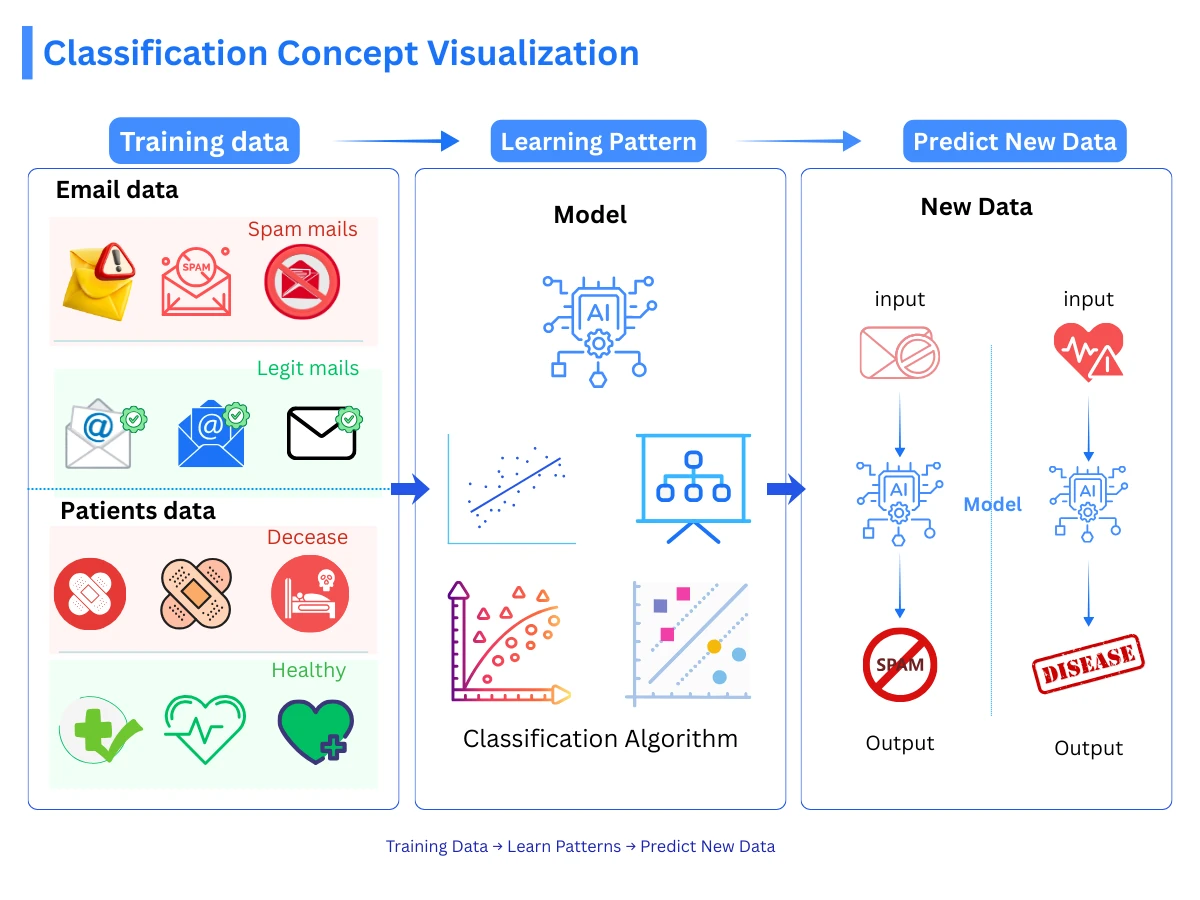
In machine learning, classification is a supervised learning task where the algorithm learns to assign input data to predefined categories (called classes or labels). Unlike regression, which predicts continuous numbers (like house prices or temperatures), classification predicts discrete categories (spam/not spam, cat/dog/bird, high risk/medium risk/low risk). The algorithm learns decision boundaries by studying labeled training examples, then applies those patterns to categorize new, unseen data.
Classification Concept - From labeled training data to predictions: the model learns decision boundaries that separate classes and applies them to new unseen data
How Classification Works: From Training Data to Predictions
Classification follows a systematic process from collecting data to making predictions. Understanding this workflow is essential for building effective classification systems. Here's the step-by-step process:
1
Collect Labeled Training Data
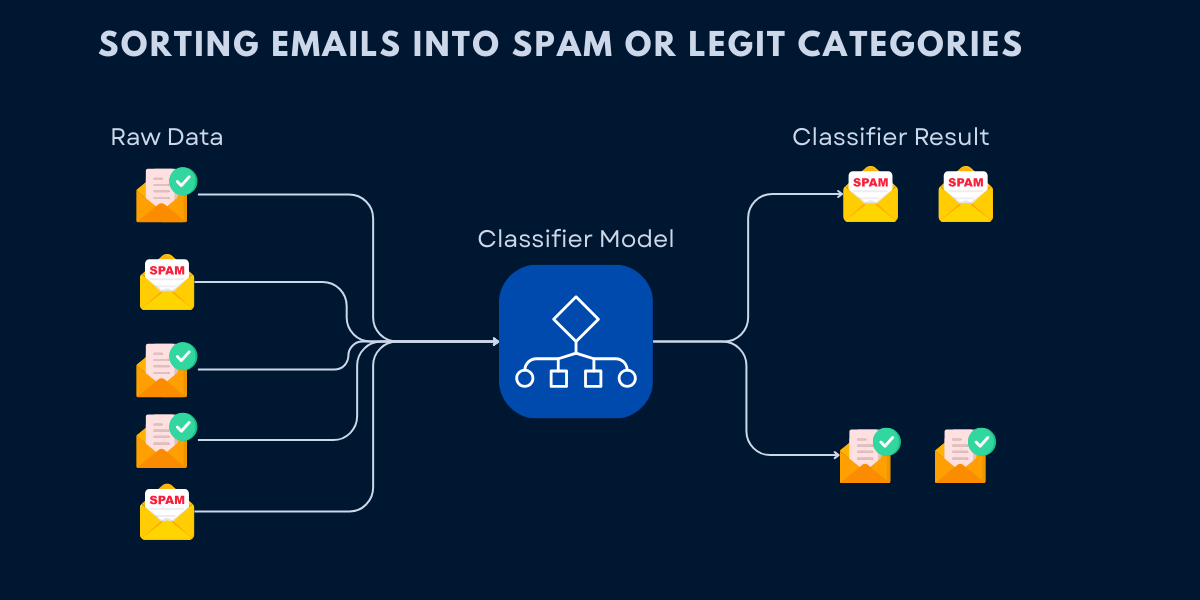
Gather examples where you know the correct category. For email spam detection, this means collecting emails already labeled as 'spam' or 'not spam'. For medical diagnosis, it's patient records with confirmed diagnoses.
2
Extract Features from Data
Identify measurable characteristics that help distinguish categories. Email features might include word frequency, sender domain, and link count. Medical features might include symptoms, test results, and patient history.
3
Train the Classification Model
The algorithm analyzes training examples to learn patterns that separate categories. It discovers which feature combinations predict each class. For example, emails with certain keywords and suspicious links tend to be spam.
4
Make Predictions on New Data
Apply the trained model to new, unlabeled examples. The model examines the features and predicts which category the example belongs to based on learned patterns.
5
Evaluate and Improve
Test predictions on data the model hasn't seen before. Measure accuracy, identify mistakes, and refine the model by adjusting features, trying different algorithms, or collecting more training data.
The key insight: classification algorithms learn from examples rather than explicit rules. You don't program "if email contains 'free money' then spam" - instead, the algorithm discovers these patterns automatically by analyzing thousands of labeled examples. This makes classification incredibly powerful for complex tasks where rule-based systems would be impractical.
Classification vs Regression: When to Use Each
Both classification and regression are supervised learning tasks, but they predict fundamentally different types of outputs. Understanding this difference is crucial for choosing the right approach for your problem.
Classification vs Regression: Core Differences
Aspect
Classification
Regression
Output Type
Discrete categories/classes
Continuous numerical values
Goal
Assign data to predefined groups
Predict a number on a continuous scale
Example Output
'spam' or 'not spam', 'cat', 'dog', or 'bird'
House price: $325,000, Temperature: 72.5 degrees
Decision Boundary
Creates boundaries separating classes
Fits a line/curve through data points
Evaluation Metrics
Accuracy, precision, recall, F1-score
MSE, RMSE, MAE, R-squared
Common Algorithms
Logistic regression, decision trees, SVM
Linear regression, polynomial regression, ridge
Use Case Examples
Email spam detection, medical diagnosis, image recognition
Stock price prediction, sales forecasting, temperature prediction
Source: Comparison based on standard supervised learning taxonomy
Quick Decision Rule
Ask yourself: "Am I predicting a category or a number?" If the answer is a label from a fixed set of options (spam/not spam, approved/rejected/pending), use classification. If the answer is a numerical value that can fall anywhere on a scale (price, temperature, probability), use regression.
Types of Classification Problems: Binary, Multiclass, and Multilabel
Classification problems come in three main varieties based on how many categories and labels are involved. Understanding these distinctions helps you choose appropriate algorithms and evaluation strategies.
Three Types of Classification
Type
Number of Classes
Labels per Example
Example Problem
Binary Classification
2 classes
1 label (A or B)
Email: spam or not spam Medical test: positive or negative Loan: approved or rejected
Multiclass Classification
3+ classes
1 label (A, B, C, or D...)
Image recognition: cat, dog, bird, or fish News category: sports, politics, tech, or entertainment Plant species: rose, tulip, daisy, or sunflower
Multilabel Classification
Multiple classes
Multiple labels possible
Movie genres: action AND comedy AND sci-fi Article tags: python AND machine-learning AND tutorial Medical conditions: diabetes AND hypertension
Source: Standard classification taxonomy from machine learning literature
Real-World Example: Content Moderation
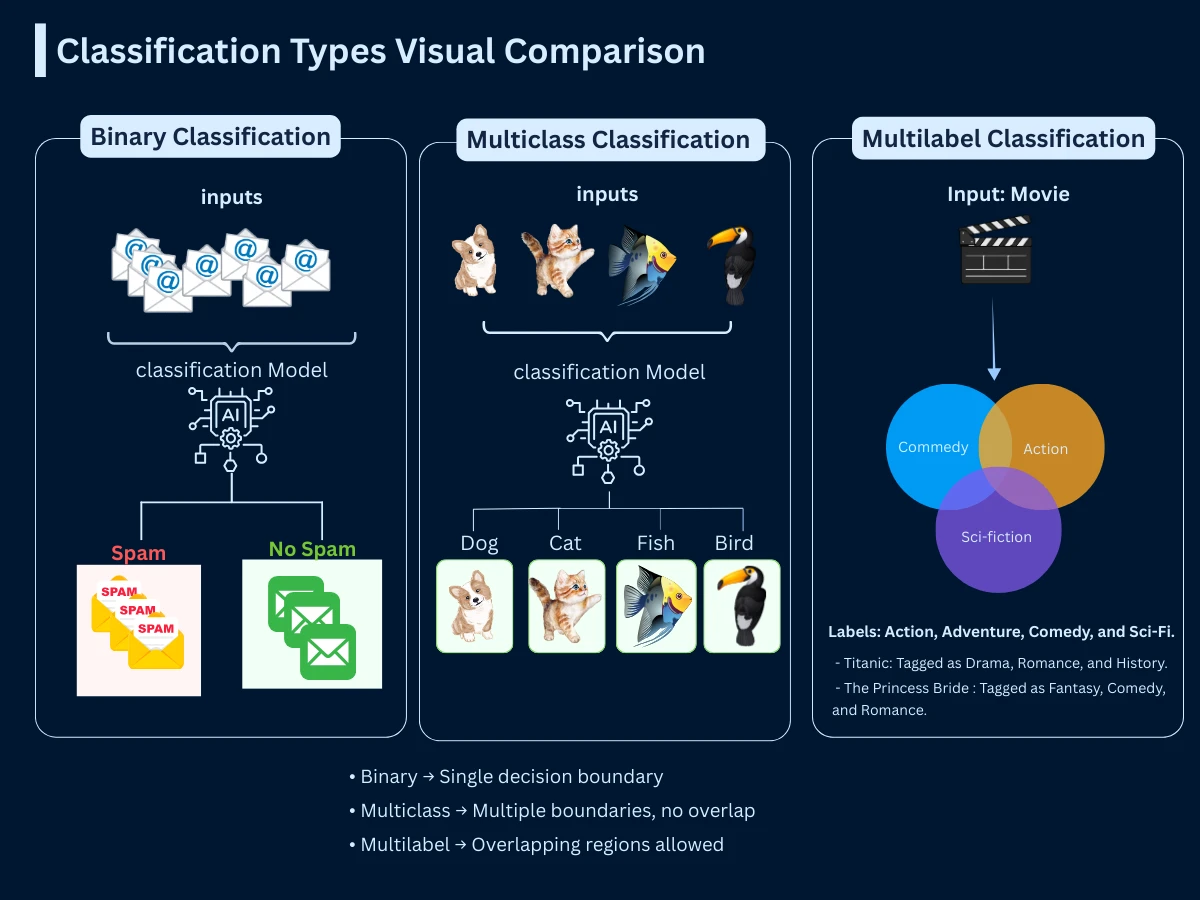
Social media platforms use all three types. Binary: Is this post safe or unsafe? Multiclass: Which category does this violate (hate speech, violence, spam, or misinformation)? Multilabel: This post contains violence AND misinformation AND spam (multiple violations at once).
Classification Types - Binary predicts one of two classes, multiclass predicts one of many classes, and multilabel allows multiple simultaneous class assignments
Common Classification Algorithms: Logistic Regression, Trees, and SVM
There are dozens of classification algorithms, each with different strengths and ideal use cases. Here are the seven most common methods you'll encounter. Each will have a dedicated tutorial page for in-depth learning - this section provides a quick introduction to help you understand when to use each approach.
Despite its name, logistic regression is used for classification, not regression. It predicts the probability that an example belongs to a particular class, then assigns the class with the highest probability. Think of it as drawing a line (or curve) that separates categories. It's fast, interpretable, and works well when classes are roughly linearly separable.
Best for: Binary classification, when you need probability estimates, interpretable results
Strengths: Fast training, works with small datasets, outputs probabilities, easy to interpret
Limitations: Assumes linear relationship, struggles with complex decision boundaries
Common uses: Email spam detection, credit default prediction, disease diagnosis
28print(f"\nProbability for first sample: {y_proba[0]}")
29print(f"Predicted class: {y_pred[0]}")
30
31# Output:
32# Accuracy: 1.000
33# Probability for first sample: [0.049 0.951]
34# Predicted class: 1
Logistic Regression outputs probabilities for each class (via predict_proba()), then assigns the class with highest probability. The Wine dataset achieves perfect accuracy because Class 0 wines are linearly separable from others.
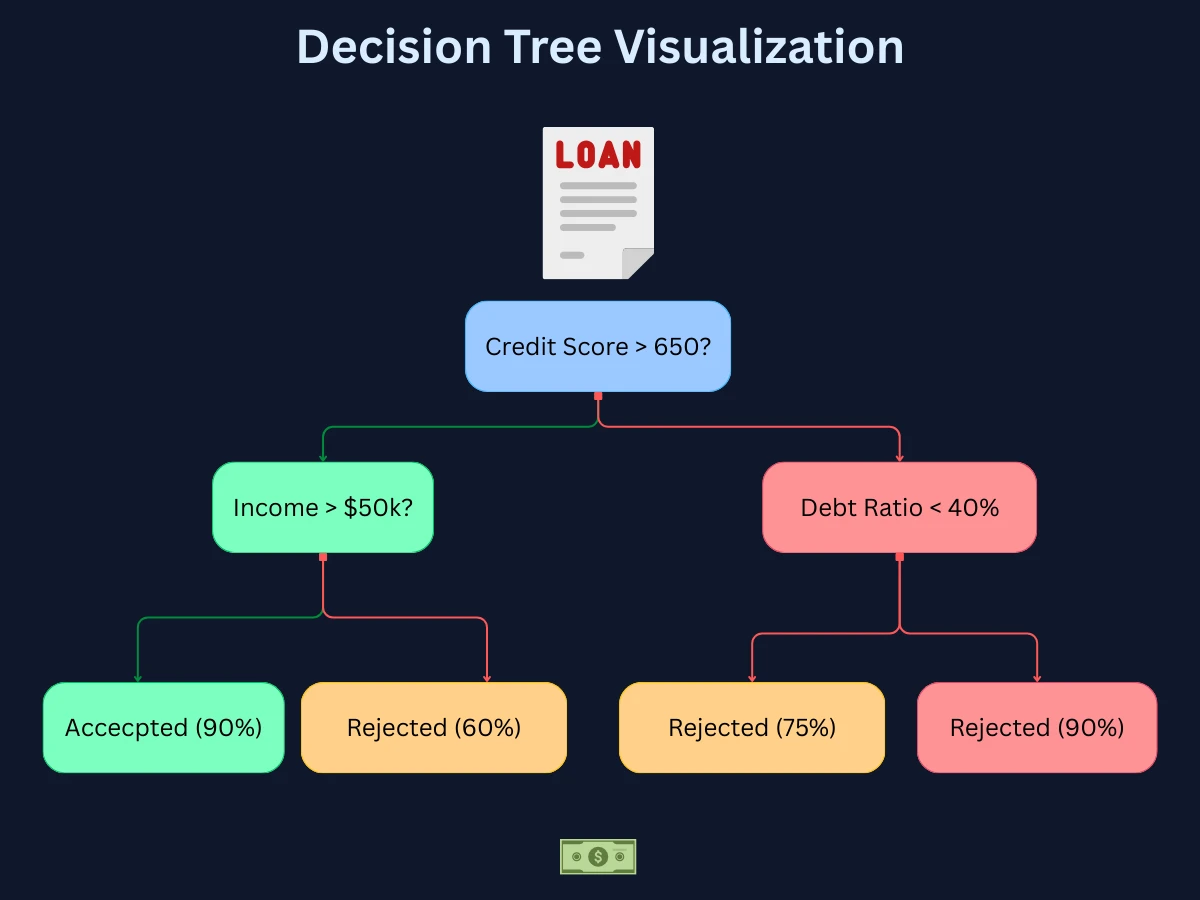
Decision trees make predictions by asking a series of yes/no questions about features, like a flowchart. Each question splits the data based on a feature value until reaching a final classification. They're highly interpretable - you can literally draw the decision-making process - and handle both numerical and categorical data naturally.
Best for: When you need interpretable models, mixed data types, non-linear relationships
Strengths: Easy to visualize and explain, handles missing values, no data scaling needed
Limitations: Prone to overfitting, unstable (small data changes cause big tree changes)
Common uses: Medical diagnosis, customer segmentation, loan approval decisions
Decision trees are highly interpretable - you can see exactly which features the model uses for decisions. The feature_importances_ attribute shows which features contribute most to predictions. Here, flavanoid content is the most important for wine classification.
Decision Tree in Action - A loan approval tree demonstrating how each node splits on a feature threshold, with branches leading to final predictions. The highlighted path shows how a specific applicant's data flows through the tree to reach a decision.
3. Random Forests: Ensemble Method Combining Multiple Decision Trees
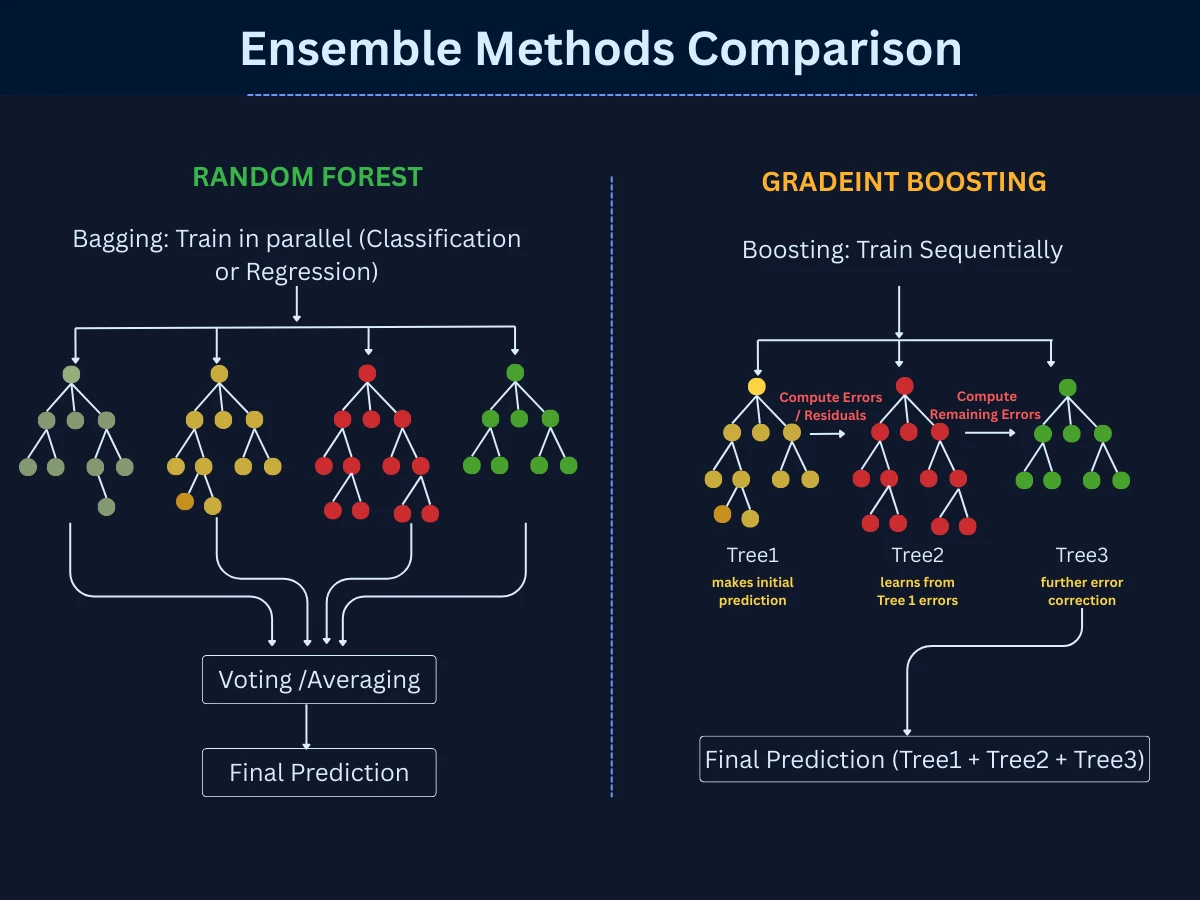
Random forests combine hundreds or thousands of decision trees, with each tree voting on the final classification. This ensemble approach reduces overfitting and improves accuracy compared to single decision trees. It's one of the most popular "out-of-the-box" algorithms because it often works well with minimal tuning.
Best for: When you want high accuracy without much tuning, complex datasets
Strengths: Very accurate, reduces overfitting, handles large datasets, feature importance
Limitations: Less interpretable than single trees, slower training and prediction
Common uses: Fraud detection, recommendation systems, gene classification
22# Feature importance (averaged across all trees)
23importances = rf.feature_importances_
24for i, (name, imp) in enumerate(zip(wine.feature_names, importances)):
25 if imp > 0.1: # Show only important features
26 print(f"{name}: {imp:.3f}")
27
28# Output:
29# Accuracy: 1.000
30# proline: 0.180
31# flavanoids: 0.153
32# color_intensity: 0.145
33# od280/od315_of_diluted_wines: 0.128
Random Forests combine 100 decision trees (controlled by n_estimators), with each tree voting on the final prediction. This ensemble approach typically achieves better accuracy than single trees. The feature importances are averaged across all trees.
Ensemble Methods - Random Forests train many trees independently in parallel and combine their votes. Gradient Boosting trains trees sequentially, with each new tree focusing on correcting the errors of previous trees for higher accuracy.
4. Support Vector Machines (SVM): Maximum-Margin Classification
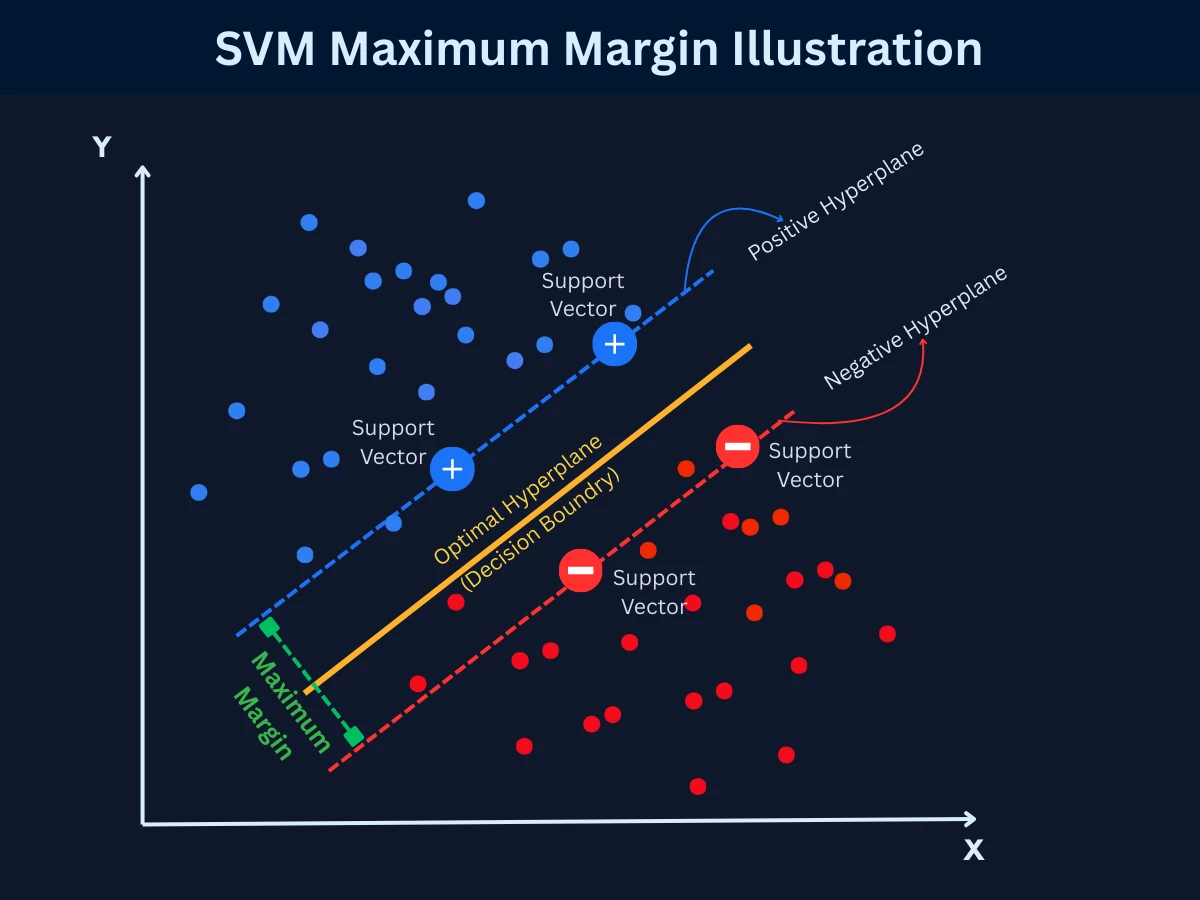
SVM finds the optimal boundary (called a hyperplane) that separates classes with the maximum margin. It's particularly powerful for high-dimensional data and can handle non-linear boundaries using the "kernel trick." While training can be slow, SVMs often achieve excellent accuracy on complex problems.
Best for: High-dimensional data (many features), when you need maximum-margin separation
Strengths: Effective in high dimensions, memory efficient, versatile (via kernels)
Limitations: Slow training on large datasets, requires feature scaling, hard to interpret
Common uses: Text classification, image recognition, bioinformatics
SVM requires feature scaling (via StandardScaler) since it's distance-based. The kernel='rbf' parameter enables non-linear decision boundaries. Support vectors are the critical data points that define the boundary.
SVM Maximum Margin - The optimal decision boundary maximizes the gap between classes. Support vectors (circled points) are the only training examples that define this boundary, making SVM memory-efficient and robust.
5. Naive Bayes: Probabilistic Classification for Text and Sparse Data
Naive Bayes applies probability theory (Bayes' theorem) to classification, calculating the probability of each class given the input features. It's called "naive" because it assumes features are independent - often unrealistic, but the algorithm works surprisingly well despite this simplification. It's extremely fast and works well with limited training data.
Best for: Text classification, when training data is limited, real-time predictions
Strengths: Very fast training and prediction, works with small datasets, handles high dimensions
Limitations: Assumes feature independence (rarely true), sensitive to irrelevant features
Common uses: Spam filtering, sentiment analysis, document categorization
Naive Bayes assumes features are independent (the 'naive' assumption). Despite this simplification, it's extremely fast and works well for text classification. GaussianNB assumes features follow a normal distribution.
Imagine you move to a new neighborhood and want to know if a house is expensive or affordable. You would probably look at the prices of the nearest houses around it - if most of them are expensive, that house likely is too. KNN works exactly the same way. Given a new data point, it measures how similar it is to every example in its training data, picks the K closest ones (the "nearest neighbors"), and predicts the category that appears most among them.
The K is just a number you choose - K=5 means "look at the 5 most similar examples." If 4 out of 5 neighbors are labeled spam, the prediction is spam. Unlike other algorithms, KNN does not learn anything during training - it simply memorizes all the data. Every prediction requires scanning the entire dataset to find the closest matches, which is why it gets noticeably slower as your data grows.
Best for: Small datasets, when decision boundaries are irregular, simple baseline models
Strengths: No training required, simple to understand, naturally handles multiclass
Limitations: Slow predictions on large datasets, sensitive to irrelevant features, requires feature scaling
Common uses: Recommendation systems, pattern recognition, anomaly detection
22print(f"\nFirst test sample's 5 nearest neighbors: {sample_neighbors[0]}")
23print(f"Predicted class: {y_pred[0]}")
24
25# Output:
26# Accuracy: 0.750
27# First test sample's 5 nearest neighbors: [120 59 94 97 135]
28# Predicted class: 1
KNN classifies based on the majority vote of k nearest neighbors. Here, n_neighbors=5 means each prediction uses the 5 closest training samples. KNN is a lazy learner - it doesn't learn a model, just stores training data.
7. Neural Networks: Deep Learning Classification for Complex Patterns
Neural networks learn hierarchical representations of data through layers of interconnected nodes. Deep neural networks (with many layers) excel at finding complex patterns in images, text, and audio. They're the foundation of modern AI breakthroughs but require large datasets and computational resources. Best saved for problems where simpler methods fail.
Best for: Image/audio/text data, complex patterns, large datasets
Strengths: Handles very complex patterns, automatic feature learning, state-of-the-art accuracy
Limitations: Requires lots of data and compute, black box (hard to interpret), many hyperparameters
Common uses: Image recognition, speech recognition, natural language processing
This neural network has 2 hidden layers with 100 and 50 neurons (controlled by hidden_layer_sizes). Neural networks can learn complex non-linear patterns but require more data and tuning. Feature scaling is essential for gradient descent convergence.
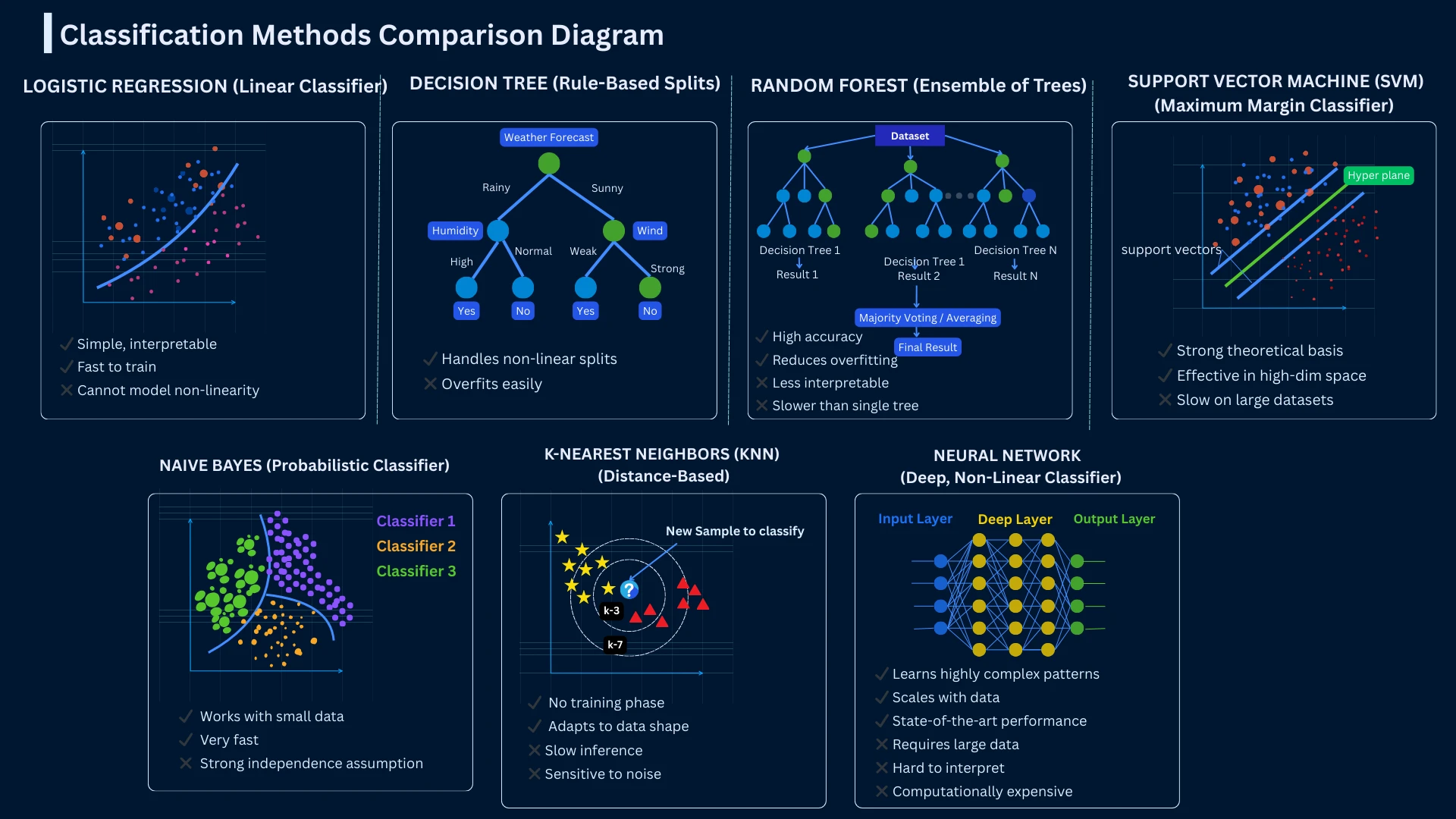
Classification Methods Comparison - Each algorithm creates different decision boundaries, making them suited to different problem types and data distributions
Quick Comparison: When to Use Each Method
Algorithm
Dataset Size
Interpretability
Training Speed
Best Use Case
Logistic Regression
Small to medium
High
Very fast
Binary problems, need probabilities
Decision Trees
Small to medium
Very high
Fast
Need explanations, mixed data types
Random Forests
Medium to large
Low
Medium
High accuracy without tuning
SVM
Small to medium
Low
Slow
High-dimensional data, text classification
Naive Bayes
Small to large
Medium
Very fast
Text classification, limited data
KNN
Small
High
Fast (no training)
Simple baseline, irregular boundaries
Neural Networks
Large
Very low
Very slow
Images, audio, text, complex patterns
Source: Comparison based on standard algorithm characteristics and use cases
How to Choose a Classification Algorithm: Step-by-Step Decision Guide
With so many algorithms available, how do you choose? Here's a practical decision framework based on your dataset characteristics and requirements:
1
Start Simple
Begin with logistic regression or a decision tree. They train fast, are easy to debug, and often give a strong baseline. If the results are good enough, you're done - no need to go further.
2
Consider Your Dataset Size
Small dataset (under 10,000 examples)? Naive Bayes or logistic regression work well with limited data. Large dataset (over 100,000 examples)? Random forests or neural networks will likely perform better.
3
Decide How Much You Need to Explain Predictions
If stakeholders need to understand why a decision was made (medical diagnosis, loan approvals), use decision trees or logistic regression. If accuracy matters more than explainability (recommendations, image tagging), neural networks or random forests are fine.
4
Check Your Number of Features
High-dimensional data (many features, like text)? SVM and naive Bayes handle this well. Low-dimensional data (a handful of features)? Most algorithms will work fine - pick by other criteria.
5
Match the Algorithm to Your Data Type
Text data: start with naive Bayes or SVM. Image or audio data: neural networks are the clear choice. Tabular / structured data: random forests are usually the best starting point.
6
Weigh Speed Against Accuracy
Need real-time predictions? Logistic regression and naive Bayes are the fastest at prediction time. If training time is not a concern and you need the highest accuracy, try SVM or random forests.
7
Experiment and Compare
Pick 2-3 methods that fit your criteria and test them on your actual data using cross-validation. No algorithm wins every problem - the best choice depends on your specific dataset and goals.
No Free Lunch Theorem
In machine learning, there's no single algorithm that works best for all problems. The "No Free Lunch" theorem proves that any algorithm performs well on some datasets and poorly on others. This is why experimentation and comparison are essential - what works for one classification problem may fail on another.
Real-World Classification Applications: Healthcare, Finance, and Technology
Classification powers countless applications across industries. Understanding where and how it's used helps you recognize opportunities to apply these techniques in your own work.
Classification Across Industries
Industry
Classification Task
Input Features
Classes/Categories
Healthcare
Disease diagnosis
Symptoms, test results, medical history, imaging
Healthy, Disease A, Disease B, Disease C
Finance
Fraud detection
Transaction amount, location, time, merchant, history
Source: Common industry applications of classification algorithms
Netflix Prize: The Power of Classification
Netflix's famous $1 million competition improved their recommendation system by 10%. The core task? Classify whether a user would rate a movie 1-5 stars (multiclass classification). The winning solution combined multiple classification algorithms - demonstrating that ensemble methods often outperform individual algorithms.
Common Classification Challenges: Imbalanced Data, Overfitting, and Leakage
Classification comes with unique pitfalls that can derail projects. Understanding these challenges helps you build more robust systems:
Imbalanced Classes: When one class vastly outnumbers others (like fraud: 99.9% legitimate, 0.1% fraudulent), algorithms often just predict the majority class. SOLUTION: Use resampling techniques (SMOTE), adjust class weights, or use appropriate metrics (F1-score instead of accuracy).
Overfitting on Training Data: Model learns training examples too well, including noise and peculiarities, failing on new data. SOLUTION: Use cross-validation, regularization, simpler models, or more training data.
Feature Engineering Challenges: Poor feature selection leads to bad predictions. Irrelevant features add noise; missing important features limits performance. SOLUTION: Use domain knowledge, feature importance analysis, and iterative testing.
Choosing Wrong Evaluation Metrics: Accuracy is misleading for imbalanced data. A spam detector that calls everything 'not spam' achieves 95% accuracy but 0% spam detection. SOLUTION: Use precision, recall, F1-score, and confusion matrices to understand true performance.
Data Leakage: Training data accidentally includes information from the future or target variable, creating artificially high accuracy that doesn't generalize. SOLUTION: Carefully separate training/test data, avoid using future information, validate temporal splits.
Multiclass Complexity: As classes increase, training becomes harder and errors multiply. A 10-class problem is much harder than binary classification. SOLUTION: Consider hierarchical classification, one-vs-rest strategies, or reformulating as multiple binary problems.
The Accuracy Trap
Accuracy alone is often misleading. In medical diagnosis, 99% accuracy sounds great - but if your algorithm misses 100% of cancer cases while correctly identifying healthy patients, it's useless. Always use multiple metrics (precision, recall, F1-score) and examine the confusion matrix to understand where your classifier succeeds and fails.
Classification Learning Path: Algorithms and Topics to Study Next
Now that you understand classification fundamentals and common methods, you're ready to explore specific algorithms and implementations. Here's the recommended learning path:
Classification Methods (this page, 16 min): Core concepts, types of classification, overview of 7 common algorithms, and when to use each
Logistic Regression Deep Dive (coming soon, 12 min): Probability estimation, sigmoid function, decision boundaries, and implementation
Decision Trees & Random Forests (coming soon, 15 min): Tree building, splitting criteria, ensemble methods, and preventing overfitting
Support Vector Machines (coming soon, 14 min): Maximum margin classifiers, kernel trick, and handling non-linear boundaries
After mastering classification methods, explore Regression Analysis to complete your supervised learning foundation, then move on to Model Evaluation Metrics to learn how to properly assess classification performance.
Frequently Asked Questions
01What's the difference between classification and clustering?
Classification is supervised learning - you have labeled training data and predict categories for new examples. Clustering is unsupervised learning - you have no labels and try to discover natural groupings in data. Use classification when you know the categories in advance (spam/not spam). Use clustering when you want to discover categories (segment customers into unknown groups).
02Which classification algorithm should I start with?
Start with logistic regression for binary problems or decision trees for multiclass problems. They're fast to train, easy to interpret, and often provide strong baselines. If performance isn't good enough, try random forests next - they often improve accuracy with minimal tuning. Save neural networks for last, only when simpler methods fail or you have image/text data.
03How much training data do I need for classification?
It depends on problem complexity and algorithm choice. Simple binary problems might work with 100-1,000 examples using logistic regression. Complex multiclass problems may need 10,000-100,000+ examples. Neural networks typically need millions of examples. As a rule of thumb: start with at least 10x examples per feature for traditional algorithms, 1,000x for deep learning. Quality matters more than quantity - clean, representative data beats huge noisy datasets.
04Can I use classification for probability estimation?
Yes! Some algorithms (logistic regression, naive Bayes, neural networks) naturally output probabilities - not just class predictions. Instead of "this email is spam," you get "this email has 87% probability of being spam." This is valuable when you need confidence scores for decision-making or want to rank predictions by certainty. Decision trees and SVM can also output probabilities with calibration.
05What is the curse of dimensionality in classification?
As the number of features (dimensions) increases, the amount of data needed for good classification grows exponentially. In high dimensions, data becomes sparse - examples are far apart, making pattern recognition harder. SOLUTION: Use dimensionality reduction (PCA), feature selection to remove irrelevant features, or algorithms that handle high dimensions well (SVM, naive Bayes, regularized models).
06How do I handle imbalanced classification problems?
Imbalanced classes (e.g., 99% not fraud, 1% fraud) cause classifiers to predict only the majority class. SOLUTIONS: (1) Resample data - oversample minority class or undersample majority class, (2) Use class weights to penalize minority class errors more, (3) Try algorithms robust to imbalance (random forests, XGBoost), (4) Use appropriate metrics (F1-score, precision-recall), (5) Generate synthetic minority examples (SMOTE).
07What's the difference between accuracy, precision, and recall?
Accuracy: Percentage of correct predictions overall (both classes). Precision: Of items predicted positive, how many are truly positive? (Minimizes false positives - important when false alarms are costly). Recall: Of all truly positive items, how many did we catch? (Minimizes false negatives - important when missing positives is costly). Use precision for spam filters (avoid blocking good emails). Use recall for disease screening (don't miss sick patients).
08Can classification algorithms explain their predictions?
Some can, others can't. Highly interpretable: Logistic regression (feature weights show importance), decision trees (visualize exact decision path). Moderately interpretable: Naive Bayes (probability contributions), linear SVM (decision boundary). Black boxes: Random forests (ensemble of trees), neural networks (complex layer interactions), non-linear SVM. For regulated industries (healthcare, finance), choose interpretable algorithms or use explainability techniques (SHAP, LIME) on black-box models.
Next Steps: Deepening Your Understanding of Classification
You now understand what classification is, how it works, and the most common methods for predicting categories. Your next step depends on your learning goals and project needs.
Your Next Step
Want to master specific algorithms? Start with Logistic Regression (coming soon) for a deep dive into probability-based classification. Or explore Regression Analysis to complete your supervised learning foundation and understand how to predict continuous values instead of categories.
Classification is the workhorse of machine learning. While deep learning gets the headlines, most business value comes from well-executed classification on structured data - fraud detection, customer churn, lead scoring, quality control. Master the fundamentals, choose algorithms wisely, and you'll solve 80% of real-world ML problems.
Andrew Ng
Co-founder of Coursera, Founder of DeepLearning.AI