Understand what machine learning is, how it works, and why it's transforming every industry
Read 14 min
Machine Learning ML Basics Fundamentals Introduction Learning from Data Paradigm Selection
Machine learning is the science of teaching computers to learn from experience, just like humans do. Instead of programming explicit rules, we show computers examples and let them discover patterns. This simple but powerful idea is revolutionizing everything from medical diagnosis to self-driving cars, and understanding it opens the door to one of the most transformative technologies of our time.
Abbreviations Used in This Article
MLMachine Learning
AIArtificial Intelligence
NLPNatural Language Processing
CNNConvolutional Neural Network
RNNRecurrent Neural Network
GPUGraphics Processing Unit
TPUTensor Processing Unit
APIApplication Programming Interface
ROIReturn on Investment
What You'll Learn in This Guide
01
What is Machine Learning? - Core definition and how ML differs from traditional programming
02
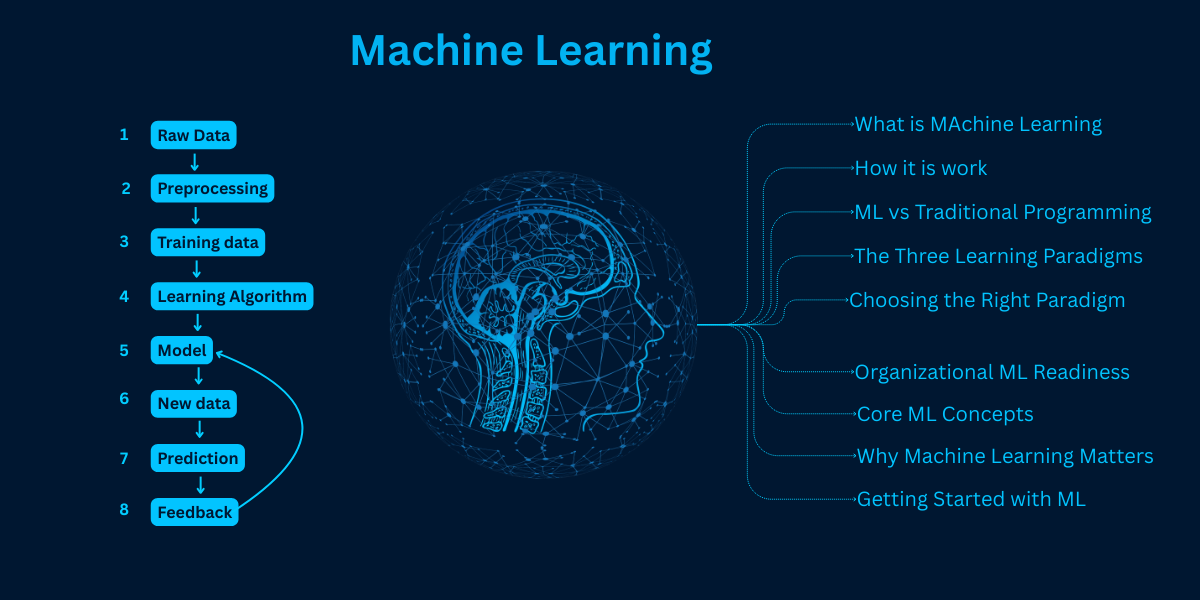
How Machine Learning Works - The four-step learning process from data to predictions
03
ML vs Traditional Programming - Understanding when to use machine learning vs coded rules
04
Three Types of Machine Learning - Supervised, unsupervised, and reinforcement learning paradigms
05
Essential ML Concepts - Training, models, predictions, and generalization explained
06
Why ML Matters - Real-world impact across healthcare, finance, and industry
07
Getting Started - Prerequisites, learning paths, and next steps in your ML journey
What is Machine Learning?
Machine learning is a method of teaching computers to make decisions and predictions by learning from data, rather than following explicitly programmed instructions. Think of it as teaching a computer the way you'd teach a child—through examples and experience, not rigid rules.
The Simple Definition
Machine Learning: The science of getting computers to learn and improve from experience without being explicitly programmed for every scenario.
Instead of writing code that says "if this, then that," we provide data that shows "when this happened, that was the result," and let the computer figure out the pattern.
Consider spam email detection. You could try writing rules: "If the email contains 'FREE MONEY' or 'CLICK HERE NOW', mark it as spam." But spammers constantly evolve their tactics, and you'd need thousands of rules to catch everything. Machine learning takes a different approach: show the computer 10,000 examples of spam and 10,000 examples of legitimate email, and it learns to recognize spam patterns you never explicitly taught it.
Traditional Programming vs Machine Learning: Email Spam Detection
Approach
How It Works
Strengths
Limitations
Traditional Programming
Write explicit rules: if contains 'FREE MONEY', mark spam
Fast, predictable, easy to understand
Requires constant manual updates, can't adapt to new patterns
Machine Learning
Learn from 20,000 labeled examples of spam and legitimate email
Adapts automatically, discovers hidden patterns, improves with more data
Requires training data, less interpretable, needs computational resources
Source: Comparison based on machine learning fundamentals from 'Pattern Recognition and Machine Learning' (Bishop, 2006) and industry spam detection practices
Machine learning is the new electricity. Just as electricity transformed almost everything 100 years ago, today I have a hard time thinking of an industry that I don't think AI and machine learning will transform in the next several years.
Andrew Ng
Founder of Google Brain, Co-founder of Coursera
How Machine Learning Works: The Learning Process
At its core, machine learning follows a simple process that mirrors how humans learn from experience. Let's break down this process step by step, using a concrete example.
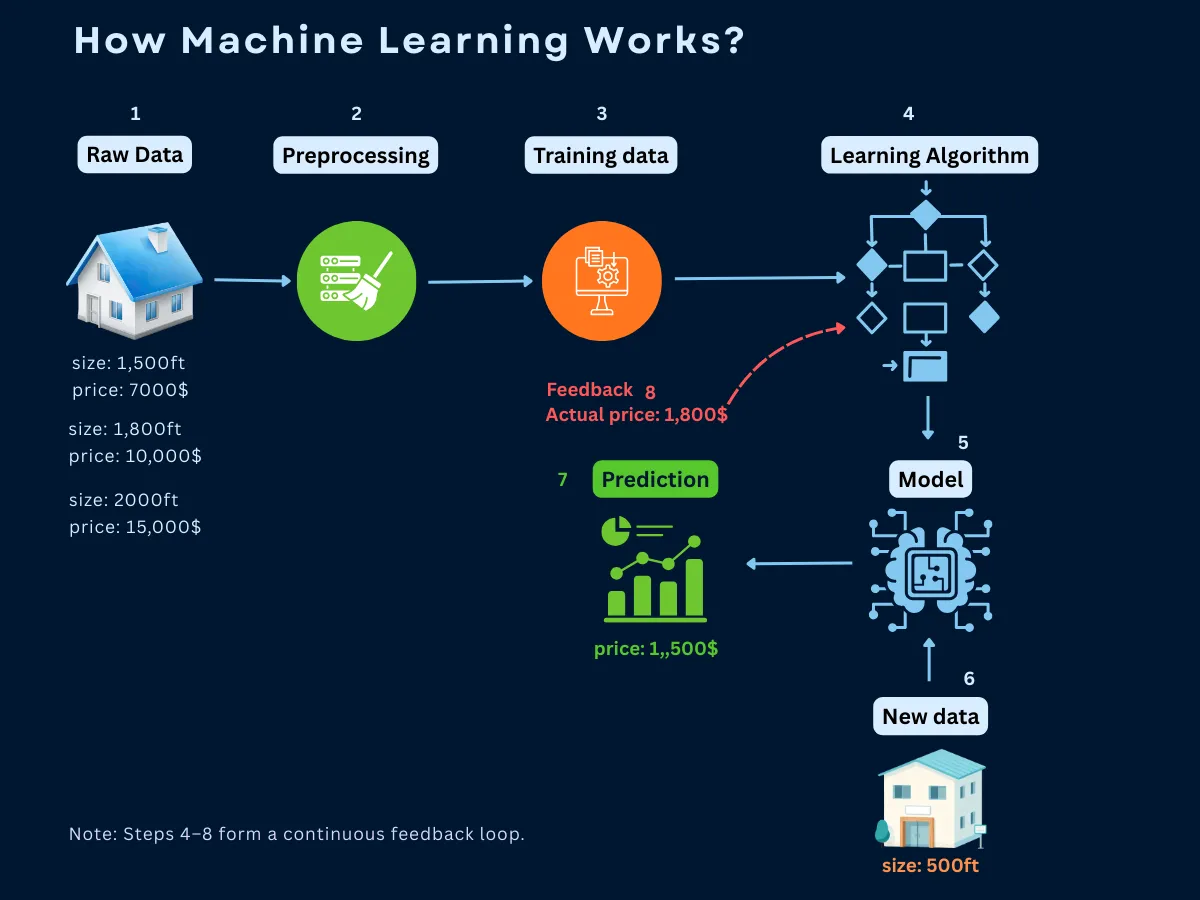
The machine learning process: data flows in, patterns are learned, and predictions come out for new unseen inputs
Machine Learning Training Process: Four Steps from Data to Predictions
Example: Teaching a Computer to Predict House Prices
Step 1: Collect Training Data - Gather historical examples with known answers. For house prices, collect data on 10,000 houses: square footage, bedrooms, location, and their actual sale prices. This is your training data.
Step 2: Choose and Train a Learning Algorithm - Select an algorithm (like linear regression or neural networks) and let it analyze the training data to discover patterns. The algorithm learns: 'Houses with more square footage tend to sell for higher prices' and 'Location dramatically affects price.'
Step 3: Create a Model - The algorithm produces a model—a mathematical representation of the patterns it discovered. Think of the model as a recipe or formula that captures what the algorithm learned from the data.
Step 4: Make Predictions - Use the model to predict prices for NEW houses it has never seen before. Input: 2,000 sq ft house, 3 bedrooms, downtown location. Output: Predicted price $450,000.
The Key Insight
The Magic of Generalization: The model doesn't just memorize the training examples—it learns general patterns that apply to new, unseen data. This is called generalization, and it's what makes machine learning so powerful.
This same four-step process applies whether you're predicting house prices, diagnosing diseases from medical images, or recommending movies on Netflix. The specifics change, but the fundamental approach remains the same: learn patterns from historical data, then apply those patterns to make predictions about new situations.
Machine Learning vs Traditional Programming: Understanding the Key Differences
Traditional programming and machine learning represent two fundamentally different approaches to solving problems with computers. Understanding this distinction is crucial to knowing when to use ML.
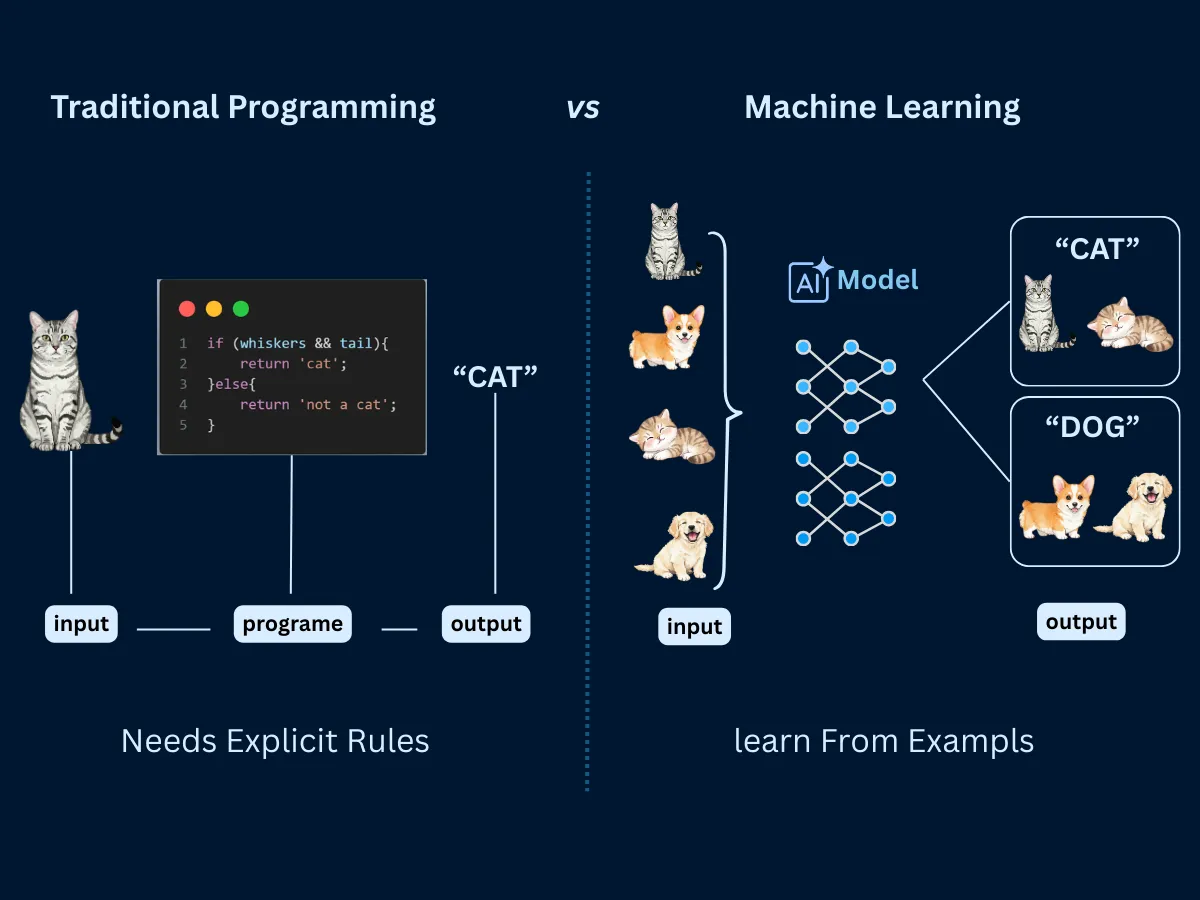
Traditional programming gives computers explicit rules; machine learning lets computers discover the rules from data
Traditional Programming vs Machine Learning: When to Use Each Approach
Source: Framework comparison synthesized from 'Hands-On Machine Learning' (Geron, 2019), 'Introduction to Machine Learning' (Alpaydin, 2020), and software engineering best practices
Real-World Example: Object Recognition
Traditional Programming Approach (Impossible): Try to write code to recognize a cat in a photo. You'd need rules like "if there are pointy ears AND whiskers AND fur pattern AND..." The combinations are endless, and the code would be impossibly complex.
Machine Learning Approach (Google Photos): Show the computer 100,000 photos of cats and 100,000 photos without cats. It automatically learns what makes a cat a cat—patterns in pixels, shapes, textures that humans can't even articulate. Result: 99%+ accuracy recognizing cats it has never seen before.
The Bottom Line: Use traditional programming when you can clearly define the rules. Use machine learning when the rules are too complex to write explicitly, or when you want systems that improve automatically with experience.
Three Types of Machine Learning: Supervised, Unsupervised, and Reinforcement Learning
Just as humans learn in different ways—from teachers, through exploration, and by trial and error—computers can learn through three distinct approaches. Understanding these paradigms is fundamental to understanding machine learning.
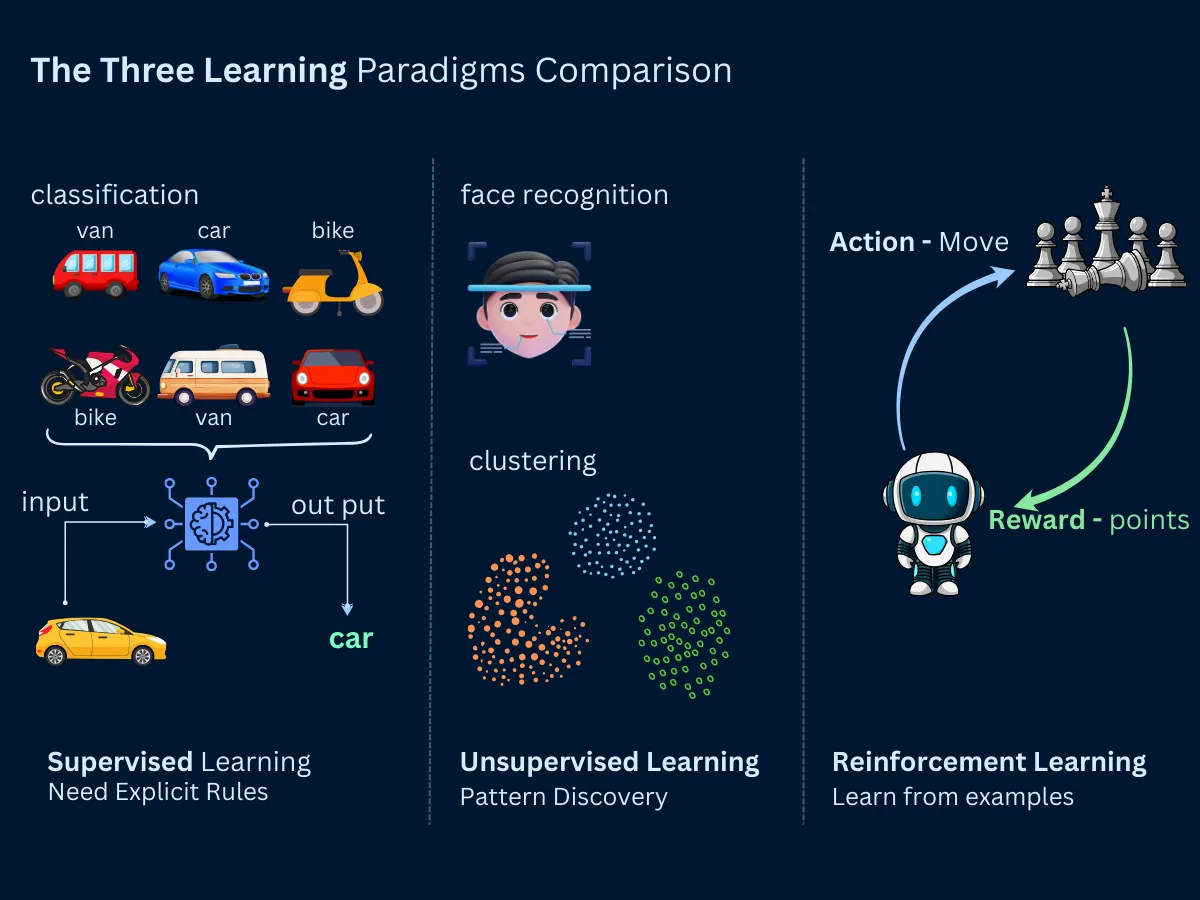
The three learning paradigms - supervised (learn from labels), unsupervised (discover patterns), reinforcement (learn from rewards)
What is Supervised Learning: Classification and Regression Explained
Supervised learning is like learning with a teacher who provides the correct answers. You show the computer many examples of inputs paired with their correct outputs, and it learns to predict outputs for new inputs it has never seen.
How Supervised Learning Works
Analogy: Teaching a child to identify animals using flashcards. You show a picture and say "This is a dog." After seeing hundreds of examples, the child learns to recognize dogs they've never seen before.
ML Example: Email spam detection. You provide 10,000 emails labeled "spam" or "not spam." The algorithm learns patterns that distinguish spam from legitimate email, then predicts labels for new incoming emails.
Two Types of Supervised Learning:
Classification: Predict categories (spam vs not spam, cat vs dog, disease present vs absent). Output is a discrete class label.
Regression: Predict numbers (house prices, temperature, stock values). Output is a continuous numerical value.
Real-World Applications: Gmail's spam filter (99.9% accuracy), medical diagnosis from X-rays, Netflix recommendations ($1B+ value), credit scoring, and Tesla Autopilot's object detection all use supervised learning.
Key Requirement: Supervised learning requires labeled data—examples where you already know the correct answer. This is its main limitation: getting high-quality labels can be expensive and time-consuming.
What is Unsupervised Learning: Clustering and Pattern Discovery
Unsupervised learning is like exploring a new city without a map or guide. The computer examines data without any labels or correct answers, discovering hidden patterns, structures, and relationships on its own.
How Unsupervised Learning Works
Analogy: Imagine sorting a pile of mixed buttons without instructions. You naturally group them by color, size, or shape—finding patterns without being told what to look for.
ML Example: Customer segmentation. Give the algorithm data on 1 million customers (age, purchases, behavior) without any labels. It automatically discovers 5 distinct customer groups: "budget shoppers," "luxury buyers," "occasional visitors," etc.
Common Unsupervised Learning Tasks:
Clustering: Group similar items together (customer segmentation, market analysis)
Anomaly Detection: Find unusual patterns (fraud detection, system monitoring)
Dimensionality Reduction: Simplify complex data while preserving patterns (data visualization)
Association Rules: Discover relationships (product recommendations, market basket analysis)
Real-World Applications: Amazon's customer segmentation for targeted marketing, PayPal's fraud detection ($1B+ in prevented fraud), Netflix's content discovery (13,000+ micro-genres), and Google News topic clustering all use unsupervised learning.
Key Advantage: No labeled data required. Unsupervised learning finds insights you didn't know to look for—the unknown unknowns.
What is Reinforcement Learning: Rewards, Actions, and Sequential Decision Making
Reinforcement learning is like training a dog with treats and corrections. The computer learns by trying actions, receiving rewards or penalties, and adjusting its behavior to maximize long-term rewards. This is the most complex learning paradigm but the most powerful for sequential decision-making.
How Reinforcement Learning Works
Analogy: Learning to play chess. You don't get immediate feedback after each move—you only know if moves were good when the game ends. Through thousands of games, you learn which strategies lead to wins (rewards) and which lead to losses (penalties).
ML Example: AlphaGo learned to play Go by playing millions of games against itself, receiving +1 for wins and -1 for losses. It discovered winning strategies that no human had thought of in 2,500 years of the game.
Key Components:
Agent: The learner or decision maker (chess program, robot, trading algorithm)
Environment: The world the agent operates in (chess board, factory floor, stock market)
Actions: Choices the agent can make (move pieces, turn left/right, buy/sell)
States: Situations the agent encounters (board positions, locations, conditions)
Rewards: Feedback on how good actions were (points, penalties, profit/loss)
Real-World Applications: DeepMind's AlphaGo (beat world champion), Tesla Autopilot (10B+ autonomous miles), Google's data center cooling (40% cost reduction), OpenAI's robotic control (solving Rubik's cube), and game AI (Grandmaster level StarCraft II) all use reinforcement learning.
Why It's Powerful: Reinforcement learning excels at problems requiring a sequence of decisions where actions have long-term consequences. It's the closest we have to how humans learn complex skills through practice and feedback.
Find Your Perfect ML Path
3-Minute Strategic Assessment
Answer 3 simple questions about your project goals, data situation, and resources. We'll recommend the best machine learning approach for your needs with clear reasoning and next steps. Select the option that best matches your situation in each question.
Step 1 of 3
Your Strategic Challenge
Every great ML project starts with the right question. Which challenge resonates most with your goals?
Essential Machine Learning Concepts: Training, Models, and Predictions
Now that you understand the three learning paradigms, let's clarify the essential concepts that apply across all machine learning approaches.
Model Training Explained: How Algorithms Learn from Data
Training is the process where algorithms learn patterns from data. During training, the algorithm analyzes your training data, adjusts internal parameters, and gradually improves its performance. Think of it as study time before an exam.
Scale of Training: GPT-3 required 355 years of computing time (compressed into weeks using thousands of GPUs) and cost $4.6 million to train. Smaller models can train in minutes on a laptop.
Machine Learning Models: Mathematical Representations of Learned Patterns
A model is the output of training—a mathematical representation of the patterns learned from data. Once trained, the model can make predictions on new data without needing to retrain. Think of it as a recipe or formula that captures what was learned.
Making Predictions with Machine Learning: Inference on New Data
Prediction (or inference) is when you use a trained model to make decisions about new, unseen data. This is the model doing its job. Predictions happen fast—often milliseconds—even if training took days.
Model Generalization: Performing Well on Unseen Data
Generalization is the model's ability to perform well on NEW data it has never seen during training. A model that memorizes training examples but fails on new data is useless. Good generalization is the holy grail of machine learning.
The ML Workflow: From Data to Deployment
Phase
What Happens
Duration
Happens Once or Repeatedly?
1. Data Collection
Gather and label training examples
Days to months
Once (then maintained)
2. Training
Algorithm learns patterns from data
Minutes to weeks
Once (then retrained periodically)
3. Validation
Test model on held-out data
Minutes
During training
4. Deployment
Put model into production
Hours to days
Once (then updated)
5. Prediction
Model makes real-time predictions
Milliseconds per prediction
Continuously
6. Monitoring
Track performance, detect issues
Continuous
Always
7. Retraining
Update model with new data
Same as training
Periodically (monthly/quarterly)
Source: ML workflow and timeline estimates based on 'Building Machine Learning Powered Applications' (Ameisen, 2020), Google's MLOps practices, and industry deployment patterns
Why Machine Learning Matters: Transforming Every Industry
Machine learning is not just another technology trend—it's a fundamental shift in how we solve problems that were previously impossible or impractical. Here's why it matters.
Machine Learning Applications: Solving Complex Problems at Scale
Some problems are simply too complex for humans to solve manually. Machine learning makes the impossible possible.
Processing Billions of Data Points: Google processes 8.5 billion searches daily, personalizing results for each user based on trillions of data points. No human team could do this.
Real-Time Decision Making: Tesla Autopilot makes 10,000+ driving decisions per second, analyzing sensor data faster than human reaction time.
Pattern Recognition at Scale: Facebook tags 350 million photos uploaded daily, recognizing faces with 97% accuracy across billions of images.
Superhuman Performance: ML systems now exceed human performance in medical image analysis, detecting cancers earlier than radiologists.
Machine Learning Industry Impact: Healthcare, Finance, and Transportation
Machine Learning's Real-World Impact Across Industries
Industry
ML Application
Impact
Value Created
Healthcare
Disease diagnosis from medical images
Earlier detection, improved outcomes
$150B+ potential value (McKinsey)
Finance
Fraud detection, algorithmic trading
Stop fraud, optimize investments
$1T+ in prevented fraud
Transportation
Self-driving vehicles, route optimization
Safety, efficiency, accessibility
$1.3T autonomous vehicle market (2030)
E-commerce
Product recommendations, demand forecasting
Increased sales, reduced waste
$2.1T in additional revenue
Manufacturing
Predictive maintenance, quality control
Reduced downtime, defect prevention
$3.7T productivity gains
Entertainment
Content recommendations, personalization
Engagement, retention, satisfaction
$1B+ value for Netflix alone
Agriculture
Crop yield prediction, pest detection
Food security, resource optimization
$240B market by 2028
Source: Economic impact estimates from McKinsey Global Institute, PwC, and industry analyses (2023-2024)
The Economic Impact
McKinsey Global Institute estimates that AI and machine learning could create $13 trillion in additional global economic value by 2030—roughly the combined GDP of China and India today.
Getting Started with Machine Learning
You now understand what machine learning is, how it works, and why it matters. Here's what you need to begin your ML journey.
Machine Learning Prerequisites: Math, Programming, and Skills Needed
The Good News
You DON'T need a PhD in mathematics or years of programming experience to start learning machine learning. The fundamentals are accessible to anyone willing to learn.
Essential Prerequisites:
Basic Mathematics: High school algebra (equations, variables, functions). Understanding of averages, percentages, and basic statistics is helpful but not required to start.
Logical Thinking: Ability to break problems into steps and think algorithmically. If you can follow a recipe or debug why your Wi-Fi isn't working, you can learn ML.
Curiosity and Persistence: ML has a learning curve. Expect to feel confused sometimes—that's normal and part of the process.
Helpful But Not Required:
Programming: Useful for implementation but NOT needed to understand ML concepts. You can learn Python alongside ML.
Advanced Math: Linear algebra, calculus, and probability help with deep understanding but aren't required for fundamentals or practical application.
Statistics: Valuable for evaluation and experimentation but can be learned as you go.
Your Learning Path: Next Steps
Follow this structured roadmap to master machine learning from foundations to advanced concepts
1
Foundations (Start Here)
Build your ML knowledge starting from the fundamentals
Learning Tip: You don't need to master everything before moving forward. Learn concepts first, add technical depth as you need it. Theory and practice should develop together.
The best way to learn machine learning is to start with the concepts and build intuition first. Don't get bogged down in mathematics at the beginning. Understand WHAT models do and WHY before diving deep into HOW they work mathematically.