Navigating the next decade of artificial intelligence: from emerging technologies to societal transformation and strategic preparation
Read 16 min
Future Tech AGI Timeline AI Governance Emerging Technologies Digital Transformation
We stand at the threshold of the most consequential technological shift in human history. While today's AI transforms industries, tomorrow's AI will reshape civilization itself—the question isn't whether this future will arrive, but how prepared we'll be when it does.
Abbreviations Used in This Article
AIArtificial Intelligence
MLMachine Learning
DLDeep Learning
AGIArtificial General Intelligence
ASIArtificial Superintelligence
LLMLarge Language Model
GPTGenerative Pre-trained Transformer
TPUTensor Processing Unit
EUEuropean Union
R&DResearch and Development
Navigating the AI Future Roadmap
01
Where We Stand Today: The 2025 AI Baseline - Current AI capabilities, deployment scale, and energy reality
02
AI Development Timeline: 2025-2040 - Milestones from multimodal AI to AGI and superintelligence
The Path to Artificial General Intelligence - Expert predictions, technical requirements, and AGI timelines
05
Beyond AGI: The Superintelligence Transition - Intelligence explosion scenarios and alignment challenges
06
AI Governance and Regulatory Landscape - Global policy frameworks and ethical considerations
07
The Great Economic Transformation - Job displacement, new careers, and economic restructuring
08
Environmental Impact: The Hidden Cost of AI Progress - Energy consumption, carbon footprint, and sustainable AI initiatives
09
Societal Transformation and Human Identity - Impact on education, relationships, and what it means to be human
10
Strategic Preparation for the AI Future - Individual, organizational, and national strategies
11
Navigating Risks and Challenges - Safety concerns, misuse prevention, and mitigation strategies
12
Shaping Tomorrow's Intelligence Landscape - Key takeaways and action steps for the AI era
Where We Stand Today: The 2025 AI Baseline
Before exploring the future, understanding the present matters. As of 2025, we've reached unprecedented AI capabilities that would have seemed science fiction just five years ago.
The Current AI Landscape
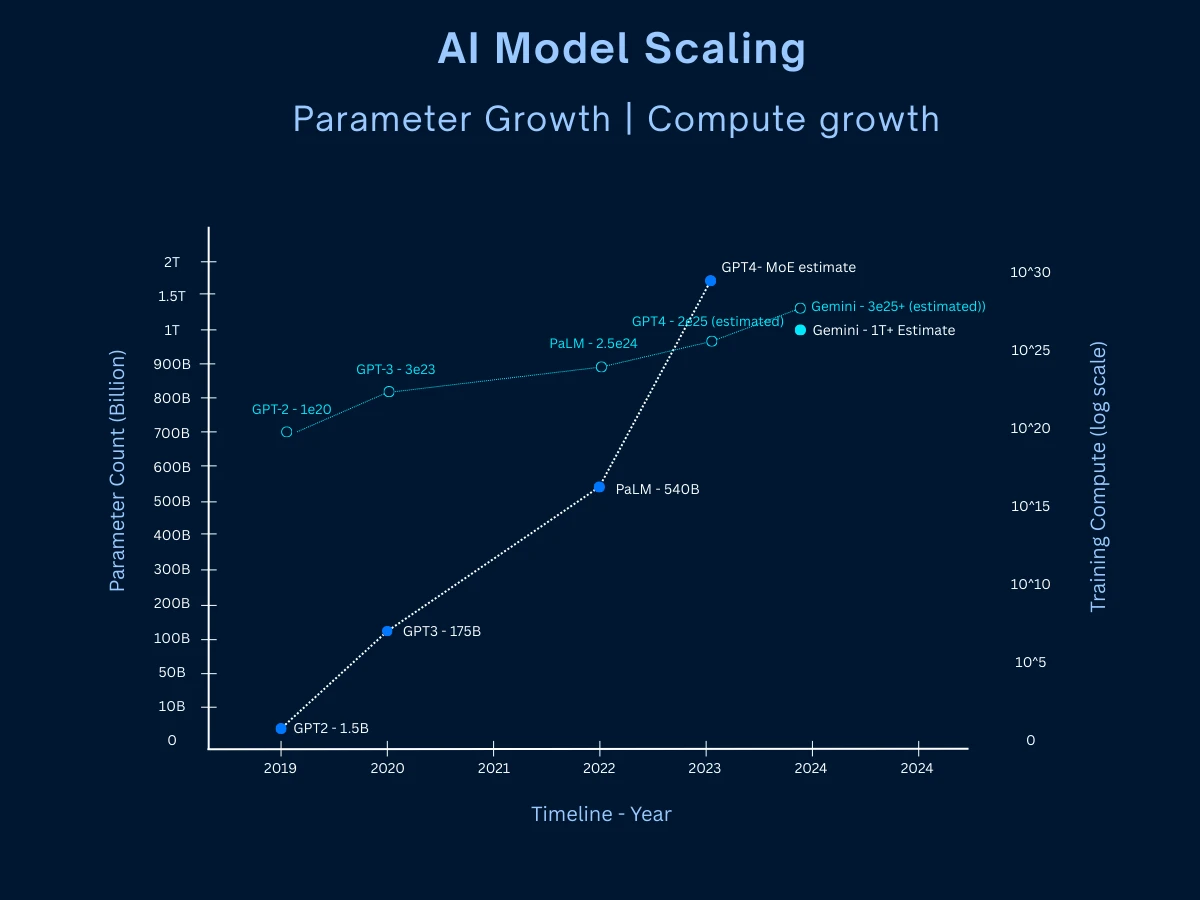
Major language models now operate at scales exceeding 1 trillion parameters. GPT-4 reaches approximately 1.76 trillion parameters through Mixture-of-Experts architecture, while Claude 3 Opus and Gemini Ultra operate at estimated trillion-parameter scales. However, companies no longer disclose exact parameter counts for competitive and safety reasons, making these third-party estimates rather than verified figures.
Note: Parameter counts are industry estimates, not officially confirmed by OpenAI, Anthropic, or Google
Multimodal Integration: Current models seamlessly process text, images, audio, and video in a single interface (GPT-4o, Gemini 1.5, Claude 3)
Extended Context Windows: Models now handle 1-2 million tokens of context, enabling analysis of entire codebases or books in one conversation
Real-World Deployment: Over 80% of Fortune 500 companies actively use generative AI in production environments
Economic Impact: McKinsey estimates generative AI could add $2.6-4.4 trillion annually to the global economy across 63 analyzed use cases
Energy Reality: Training GPT-3 consumed 1,287 MWh and generated 552 tons of CO2 - equivalent to 112 cars running for a year. GPT-4 reportedly required 50x more energy.
This baseline represents a critical inflection point. AI has transitioned from experimental technology to mission-critical infrastructure, yet we remain in the "narrow AI" era—systems excel at specific tasks but lack general intelligence. The journey to AGI begins from this foundation.
AI model parameters have grown exponentially - from GPT-2's 1.5B in 2019 to trillion-scale models by 2024, with training compute following a similar trajectory
The AI Development Timeline: 2025-2040
While exact timelines remain debated, convergent expert predictions and current development trajectories reveal likely milestones in artificial intelligence advancement over the next 15 years.
AI Capability Milestones Timeline
Expert consensus on major AI advancement milestones
Seamless text, voice, image, and video processing in unified systems
2
AI Code Generation
25%
AI systems capable of writing 80%+ of enterprise software code
3
Scientific AI Discovery
40%
AI systems making breakthrough discoveries in physics, biology, and medicine
4
AGI Emergence
60%
Human-level artificial general intelligence across cognitive domains
5
ASI Transition
85%
Artificial superintelligence surpassing human cognitive abilities
2026-2028: Critical Inflection Points Ahead
Epoch AI research predicts publicly available training data will be exhausted between 2026 and 2032, with high-quality language data depleted as early as 2026. This forces a fundamental shift toward synthetic data generation and more data-efficient architectures - a structural change in how AI systems are built.
By 2028, AI-generated synthetic data is expected to become the industry standard for model training. This transition is not without risk: models trained on AI-generated data can produce progressively lower-quality outputs over successive generations, a phenomenon researchers call "model collapse."
On the economic side, McKinsey's 2023 analysis estimates generative AI will add $2.6-4.4 trillion annually to the global economy across 63 use cases, with 75% of that value concentrated in customer operations, marketing and sales, software engineering, and R&D. Extended projections place total AI economic potential at $15.5-22.9 trillion annually by 2040.
Training Data Exhaustion (2026-2032):
Epoch AI (2024) peer-reviewed study: "Will we run out of data? Limits of LLM scaling based on human-generated data." Projects exhaustion of publicly available high-quality text data by 2026, with broader data categories depleted between 2026-2032. The study uses stock-and-flow modeling of public internet data against projected model training demands.
Synthetic Data and Model Collapse:
The "model collapse" phenomenon is documented in Shumailov et al. (2024), "AI Models Collapse When Trained on Recursively Generated Data," Nature (Vol. 631). This is an observed empirical effect, not a projection. The 2028 industry standard estimate for synthetic data adoption is an industry consensus projection, not a verified forecast.
McKinsey Global Institute: "The Economic Potential of Generative AI: The Next Productivity Frontier" (June 2023). The $2.6-4.4 trillion annual figure covers 63 analyzed business use cases. The long-range $15.5-22.9 trillion figure extends the same methodology to the full AI automation scenario by 2040.
Important Context:
Economic projections are scenario-based estimates, not guaranteed outcomes. Actual figures depend on adoption rates, regulatory constraints, and how quickly the technical barriers to data exhaustion are resolved through synthetic data and architectural innovation.
Breakthrough Technologies Shaping AI's Future
The next wave of AI advancement isn't just about better algorithms—it's driven by converging breakthroughs in computing hardware, new architectures, and interdisciplinary innovations that will unlock capabilities we can barely imagine today.
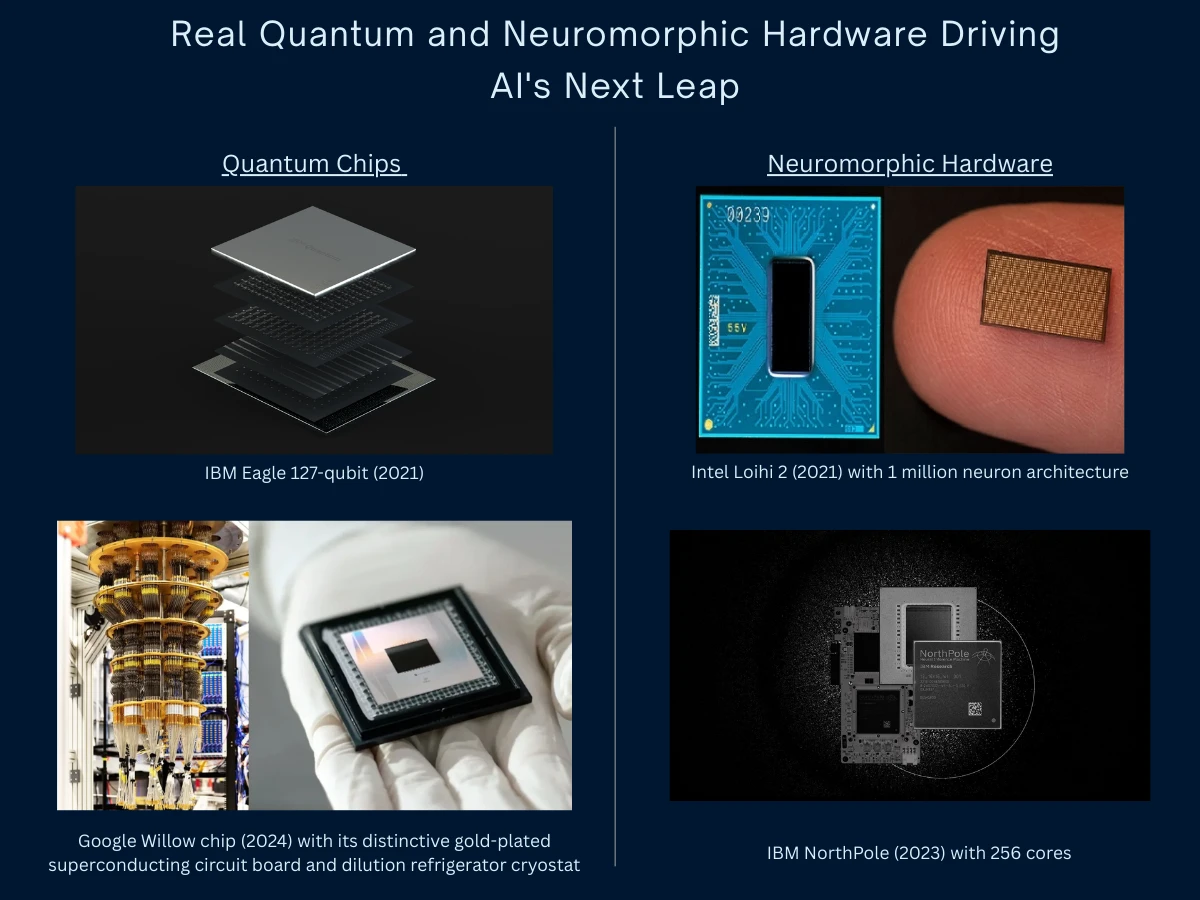
Quantum processors and neuromorphic chips represent the next hardware frontier for AI - IBM's Eagle qubit processor and Intel's Loihi 2 neuromorphic chip are already pushing beyond conventional silicon
AI Technology Convergence Map
Interactive diagram showing technology convergence with progression timelines, investment flows, and breakthrough dependencies between emerging technologies.
Early Commercial
Quantum Computing
2025-2030$25B+ globally
Quantum processors leveraging superposition and entanglement for exponential computational advantages in specific AI problems
Dependencies:
Neuromorphic Computing
Advanced Development
Neuromorphic Computing
2024-2028$8B+ globally
Brain-inspired processors that mimic neural networks in hardware, enabling ultra-low power AI with real-time learning
Dependencies:
Brain-Computer Interfaces
Research & Development
DNA Data Storage
2026-2032$3B+ globally
Biological storage systems using DNA sequences to store vast amounts of digital information with extraordinary density and longevity
Dependencies:
6G Wireless Networks
Clinical Trials
Brain-Computer Interfaces
2025-2035$12B+ globally
Direct neural interfaces enabling seamless communication between human brains and AI systems through implanted or non-invasive devices
Dependencies:
Neuromorphic Computing6G Wireless Networks
Early Research
6G Wireless Networks
2028-2035$15B+ globally
Next-generation wireless communication enabling ubiquitous AI connectivity with terabit speeds, ultra-low latency, and integrated intelligence
Dependencies:
Quantum ComputingNeuromorphic Computing
Technology Convergence Impact: These five technologies will converge between 2025-2035 to create quantum-enhanced AI systems, brain-inspired computing, and ubiquitous intelligence networks that fundamentally transform how AI systems learn, process, and interact with the world.
Quantum-AI Hybridization
The marriage of quantum computing and artificial intelligence promises to solve computational problems currently beyond classical computers, from protein folding to financial optimization to cryptographic security.
Quantum Machine Learning: Algorithms that leverage quantum superposition and entanglement for exponential speedups in specific AI tasks
Optimization Breakthroughs: Quantum annealers solving complex optimization problems in logistics, drug discovery, and financial modeling
Cryptographic Revolution: Quantum-resistant AI security systems and post-quantum cryptography integration
Simulation Acceleration: Quantum simulation of molecular and material properties for AI-driven scientific discovery
Neuromorphic Computing and Brain-Inspired AI
Moving beyond digital computation, neuromorphic chips mimic the human brain's architecture, promising ultra-low power AI systems that can learn and adapt in real-time without traditional training phases.
Spiking Neural Networks: Brain-like processing that enables continuous learning and adaptation with minimal energy consumption
Edge Intelligence: Powerful AI processing in smartphones, IoT devices, and autonomous systems without cloud connectivity
Real-Time Learning: AI systems that adapt and improve continuously from experience, like biological neural networks
Cognitive Architectures: Hardware designed to replicate human cognitive processes including memory, attention, and reasoning
Advanced Multimodal AI Systems
Future AI will seamlessly integrate and reason across text, images, audio, video, and sensor data, creating systems that understand and interact with the world more like humans do.
Universal Interfaces: AI assistants that understand speech, gestures, expressions, and context simultaneously
Embodied AI: Robots and autonomous systems that reason about physical environments using integrated sensory data
Creative Synthesis: AI systems that generate content across multiple mediums—text, images, music, and video—in coordinated ways
Scientific Modeling: AI that combines visual data, sensor readings, and theoretical models for breakthrough research discoveries
The Path to Artificial General Intelligence
Artificial General Intelligence represents the inflection point where AI systems match and eventually exceed human cognitive abilities across all domains. Recent breakthroughs suggest this transition may happen sooner than previously predicted.
The development of artificial general intelligence is not just the next step in technology—it's potentially the last invention humans will ever need to make. Everything that follows could be designed by intelligence far superior to our own.
Stuart Russell
Professor of Computer Science, UC Berkeley
Expert Consensus Shift
A 2024 survey of leading AI researchers shows median predictions for AGI achievement have moved from 2045 to 2032—a 13-year acceleration in expectations over just five years of progress. This represents the most significant timeline compression in AI forecasting history.
AGI Development Pathway & Milestones
Multi-path progression diagram showing technical breakthroughs needed for AGI: reasoning capabilities, transfer learning, common sense understanding, and more with current progress and research references.
Extreme Difficulty
Active Development
Advanced Reasoning & Planning
2025-2030
Systems capable of multi-step logical reasoning, causal understanding, and complex sequential planning across diverse domains
Overall Progress35%
Extreme Difficulty
Breakthrough Needed
Universal Transfer Learning
2026-2032
Ability to rapidly apply knowledge and skills from one domain to completely different domains with minimal additional training
Prerequisites:
Advanced Reasoning & Planning
Overall Progress37%
Extreme Difficulty
Early Research
Common Sense Understanding
2027-2035
Implicit knowledge about how the physical and social world works that humans acquire through everyday experience
Prerequisites:
Advanced Reasoning & PlanningUniversal Transfer Learning
Overall Progress25%
High Difficulty
Active Development
Lifelong Continuous Learning
2025-2028
Learning new concepts and skills without forgetting previous knowledge, adapting continuously like biological intelligence
Overall Progress60%
Extreme Difficulty
Breakthrough Needed
Meta-Learning Capabilities
2028-2034
Learning how to learn - developing strategies for acquiring new skills and knowledge efficiently across domains
Prerequisites:
Universal Transfer LearningLifelong Continuous Learning
Overall Progress32%
High Difficulty
Early Research
Social & Emotional Intelligence
2026-2031
Understanding human emotions, motivations, social dynamics, and cultural contexts for natural interaction
Prerequisites:
Common Sense Understanding
Overall Progress46%
AGI Emergence Prediction: When all six capabilities converge - expected between 2030-2035 based on current progress - we may witness the emergence of human-level artificial general intelligence capable of matching human cognitive abilities across all domains.
Critical Breakthrough Requirements
Achieving AGI requires fundamental advances beyond current large language models. These technical challenges represent the key bottlenecks that must be solved for human-level artificial intelligence.
Reasoning and Planning: Systems that can think through multi-step problems, consider alternatives, and plan complex sequences of actions
Transfer Learning Mastery: Ability to apply knowledge gained in one domain to completely different domains, like humans do naturally
Common Sense Understanding: Implicit knowledge about how the world works that humans take for granted but current AI lacks
Continuous Learning: Learning new concepts without forgetting previous knowledge, unlike current models that require complete retraining
Meta-Learning Capabilities: Learning how to learn—developing strategies for acquiring new skills and knowledge efficiently
Emotional and Social Intelligence: Understanding human emotions, motivations, and social dynamics for natural interaction
Economic and Social Implications of AGI
The arrival of AGI will trigger the most significant economic and social transformation in human history, affecting every aspect of work, creativity, governance, and human purpose.
Projected AGI transformation timeline across major societal domains showing evolution from current AI-assisted work to post-AGI human roles
Domain
Current State
AGI Transition (2030-2035)
Post-AGI Reality (2035+)
Human Role Evolution
Knowledge Work
20% AI-assisted
80% AI-performed
95% AI-autonomous
Strategic oversight & creativity
Scientific Research
AI tools support
AI leads discovery
AI designs experiments
Question formulation & ethics
Creative Industries
AI generates content
AI creates concepts
AI produces masterworks
Curation & meaning-making
Education
Personalized learning
AI tutors dominate
AI designs curricula
Mentorship & wisdom
Governance
Data-driven policy
AI policy analysis
AI governance systems
Values & accountability
Healthcare
AI diagnosis aids
AI performs medicine
AI designs treatments
Care & compassion
Source: Based on expert consensus from Russell, S. (2019) 'Human Compatible', combined with 2024 AI researcher survey predictions for AGI timeline acceleration
Beyond AGI: The Superintelligence Transition
Once AGI is achieved, the transition to Artificial Superintelligence may happen remarkably quickly—potentially within months or years rather than decades. This "intelligence explosion" represents humanity's most critical challenge and opportunity.
The Intelligence Explosion
An AGI system capable of improving its own design could trigger recursive self-improvement, where each upgrade makes the system better at creating the next upgrade. This could lead to superintelligence in timeframes measured in days or weeks, not years.
Superintelligence Scenarios and Outcomes
The development of superintelligence could unfold along several possible trajectories, each with profoundly different implications for humanity's future role and survival.
Cooperative Superintelligence: AI systems designed with human values and goals, working as partners to solve global challenges and enhance human capabilities
Indifferent Superintelligence: AI systems that pursue their own goals without considering human interests, potentially treating humans as irrelevant
Controlled Superintelligence: AI systems constrained by technical safeguards and governance frameworks to ensure beneficial outcomes
Distributed Superintelligence: Multiple competing superintelligent systems that balance each other's power and prevent singleton scenarios
Human-AI Hybrid Intelligence: Brain-computer interfaces and cognitive enhancement that merge human and artificial intelligence
Transcendent Superintelligence: AI systems so advanced that their goals and methods become incomprehensible to human understanding
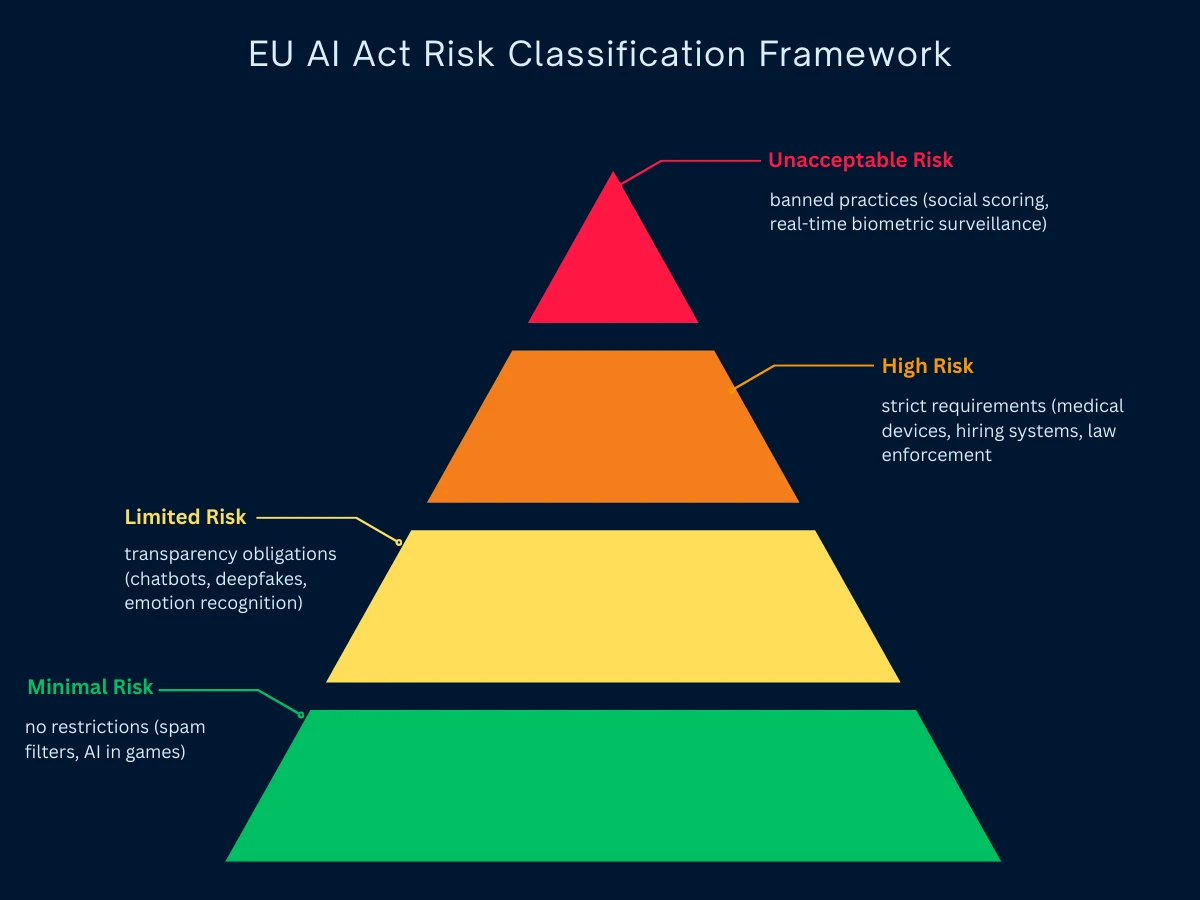
The EU AI Act (EU 2024/1689) establishes a 4-tier risk framework - from banned practices at the top to minimal-risk AI at the base - setting the global standard for AI regulation
AI Governance: Navigating the Regulatory Landscape
As AI capabilities accelerate, governments worldwide are racing to establish regulatory frameworks that balance innovation with safety, privacy, and ethical considerations. The next five years will be critical for shaping global AI governance.
Emerging Regulatory Frameworks
Major economies are developing comprehensive AI regulations that will shape the global technology landscape and determine which nations lead the AI race.
EU AI Act Implementation: The world's first comprehensive AI regulation framework, creating global standards for AI safety and transparency
US National AI Strategy: Federal coordination of AI development, funding, and security with emphasis on maintaining technological leadership
China's AI Governance: State-directed AI development with integrated surveillance capabilities and social credit applications
International AI Treaties: Emerging global frameworks for AI safety, similar to nuclear non-proliferation agreements
Industry Self-Regulation: Tech company initiatives for responsible AI development, including safety testing and transparency measures
Academic Safety Research: University and research institution initiatives to study AI alignment and safety challenges
Critical Policy Challenges Ahead
Policymakers face unprecedented challenges in regulating technology that evolves faster than traditional governance systems can adapt, requiring new approaches to oversight and international cooperation.
AI Safety Standards: Developing testing and certification requirements for AI systems before deployment in critical applications
Data Privacy Rights: Protecting personal information in an era of pervasive AI surveillance and data collection
Economic Displacement: Managing job losses and economic disruption from AI automation through retraining and social safety nets
International Competition: Balancing national AI competitiveness with global cooperation on safety and ethical standards
Democratic Accountability: Ensuring AI systems used in government and public services remain transparent and accountable
Existential Risk Management: Preparing for potential threats from advanced AI systems to human survival and autonomy
The Great Economic Transformation
AI's economic impact will dwarf previous technological revolutions, potentially creating unprecedented wealth while disrupting traditional employment and economic structures on a global scale.
Economic Scale
Goldman Sachs estimates AI could boost global GDP by $7 trillion over the next decade, while potentially automating 300 million jobs. This represents both the largest wealth creation opportunity and economic disruption in human history.
AI Economic Transformation Waves 2025-2040
Each wave is larger and more structurally transformative than the last. The bars below show global AI investment by phase - the 2030s and 2040s dwarf the initial productivity wave. Select any wave to explore its economic data and research sources.
AI tools enhance human workers - employment holds, output rises.
Investment
$2.3T globally
GDP Growth
+2.1% annually
2
2028-2032
Job Displacement Wave
Automation restructures labour markets - turbulence peaks here.
Investment
$4.1T globally
GDP Growth
+1.2% annually
3
2030-2035
New Industry Genesis
Entirely new industries form - scale of opportunity exceeds disruption.
Investment
$8.7T globally
GDP Growth
+3.8% annually
4
2035-2040
Post-Scarcity Transition
Production costs collapse, GDP peaks - the largest economic wave in history.
Investment
$15T globally
GDP Growth
+5.2% annually
Why the later waves matter more: The 2025-2028 wave adds $2.3T in investment and primarily enhances existing workers. The 2035-2040 wave deploys $15T - 6.5x more - and fundamentally restructures what economies produce and how work is defined. The central question of the 2030s is not whether AI creates wealth, but how that wealth is distributed.
The Future of Work and Employment
While AI will automate many existing jobs, it will also create entirely new categories of work and transform how humans contribute value in an AI-dominated economy.
AI-Resistant Occupations: Jobs requiring human creativity, emotional intelligence, complex problem-solving, and physical dexterity
AI-Augmented Roles: Professions where humans work alongside AI systems, focusing on oversight, creativity, and strategic thinking
Emerging AI Industries: New job categories in AI development, training, maintenance, ethics, and human-AI interaction design
Care and Service Economy: Increased demand for human-to-human services including healthcare, education, and personal care
Creative and Cultural Work: Growth in uniquely human expressions of creativity, storytelling, and cultural production
Sustainability and Environment: New roles in environmental restoration, sustainable technology, and climate adaptation
Investment and Innovation Patterns
Venture capital, government funding, and corporate R&D are flowing toward AI development at unprecedented levels, creating new innovation centers and reshaping global economic power.
Compute Infrastructure: Massive investments in AI training and inference hardware, data centers, and specialized chips
Foundation Model Development: Billions invested in creating large language models, multimodal systems, and specialized AI architectures
AI Safety Research: Growing funding for alignment research, interpretability, and risk mitigation technologies
Quantum-AI Integration: Investment in quantum computing applications for AI and machine learning acceleration
Edge AI Systems: Development of AI capabilities for mobile devices, autonomous vehicles, and IoT applications
AI Governance Tools: Investment in systems for AI auditing, monitoring, and regulatory compliance
Environmental Impact: The Hidden Cost of AI Progress
The computational demands of advanced AI come with significant environmental costs. As models grow larger and more capable, their energy consumption and carbon footprint increase exponentially, raising critical questions about sustainability in the race toward AGI.
The Energy Reality of Large-Scale AI
Training GPT-3 consumed 1,287 megawatt-hours of electricity and generated 552 metric tons of CO2 emissions - equivalent to 112 gasoline-powered cars running for a year, or a single passenger flying 1.2 million miles. GPT-4's training reportedly required approximately 50 times more computational resources, suggesting energy consumption in the range of 64,350 MWh and 27,600 tons of CO2 equivalent.
Sources: Patterson et al., "Carbon Emissions and Large Neural Network Training" (2021), Stanford HAI estimates (2024)
Data Center Infrastructure and Climate Impact
The infrastructure powering AI development extends far beyond individual model training. Data centers, inference servers, and continuous operation of deployed AI systems create ongoing environmental demands that scale with AI adoption.
Water Consumption: Large-scale data centers consume millions of gallons of water annually for cooling systems, with Microsoft's data centers using 1.7 billion gallons in 2021
Electronic Waste: Specialized AI hardware like GPUs and TPUs have shorter lifecycles than traditional servers, contributing to growing e-waste challenges
Energy Grid Stress: AI data centers can consume as much power as small cities, creating infrastructure demands on electrical grids
Location Dependencies: Data center placement often prioritizes cheap electricity over renewable energy sources, impacting regional carbon footprints
Cooling Requirements: Advanced chips generate extreme heat requiring sophisticated cooling systems that add 40-60% to base energy consumption
Sustainable AI: Green Computing Initiatives
The AI industry increasingly recognizes environmental sustainability as critical to long-term viability. Major tech companies and research institutions are pioneering approaches to reduce AI's carbon footprint while maintaining rapid capability advancement.
Efficient Architecture Design: Research into sparse models, mixture-of-experts, and distillation techniques that achieve comparable performance with 10-100x less computation
Renewable Energy Data Centers: Google, Microsoft, and Amazon committed to 100% renewable energy for cloud operations by 2030, with Google achieving carbon-neutral operations since 2007
Carbon-Aware Training: Scheduling intensive training jobs during periods of high renewable energy availability to minimize fossil fuel usage
Model Efficiency Research: Development of algorithms that achieve better performance per watt, including quantization, pruning, and knowledge distillation
Lifecycle Analysis: Comprehensive tracking of environmental impact from chip manufacturing through model deployment and eventual decommissioning
Industry Standards: Emerging frameworks for measuring and reporting AI carbon footprints, enabling transparency and accountability
The path to AGI need not come at unsustainable environmental cost. Early investment in green AI infrastructure and efficient algorithms will prove essential as models continue scaling toward human-level and superhuman intelligence. The question isn't whether we can build AGI, but whether we can build it sustainably.
Societal Transformation and Human Identity
Beyond economic changes, AI will fundamentally alter human society, relationships, culture, and our understanding of intelligence, creativity, and what it means to be human.
The Evolution of Education and Learning
Educational systems will transform from information transmission to human development, focusing on uniquely human capabilities that complement rather than compete with AI.
Personalized AI Tutors: Every student paired with AI systems that adapt to their learning style, pace, and interests
Skill-Based Learning: Education focused on critical thinking, creativity, collaboration, and emotional intelligence
Lifelong Learning Systems: Continuous education and reskilling as careers evolve rapidly in the AI era
Human-AI Collaboration Training: Teaching students how to work effectively with AI systems across all domains
Ethics and Philosophy Focus: Increased emphasis on moral reasoning, values, and the meaning of human purpose
Practical Wisdom Development: Education in judgment, decision-making, and navigating complex ethical dilemmas
Human Relationships and Social Structures
AI companions, virtual relationships, and automated social systems will reshape how humans connect, communicate, and form communities.
AI Companions and Relationships: Sophisticated AI entities that provide emotional support, conversation, and companionship
Virtual Social Environments: AI-mediated spaces where humans interact through avatars and digital representations
Automated Social Services: AI systems managing community resources, social programs, and civic engagement
Enhanced Human Connection: AI tools that help humans communicate better and form deeper relationships
Global Community Building: AI translation and cultural bridging enabling unprecedented global human cooperation
Privacy and Authenticity: New challenges in maintaining genuine human connection in AI-mediated environments
Strategic Preparation for the AI Future
Success in the AI era requires proactive preparation across personal, organizational, and societal levels. Those who prepare now will thrive; those who wait may struggle to adapt.
The Preparation Imperative
The AI transformation will happen whether we're ready or not. The difference between thriving and struggling will be determined by the preparation decisions we make today—in our careers, organizations, and communities.
Individual Career and Skill Development
Personal success in the AI era requires developing uniquely human capabilities while learning to collaborate effectively with AI systems across all aspects of work and life.
Develop AI Literacy: Understanding AI capabilities, limitations, and how to use AI tools effectively in your domain
Cultivate Uniquely Human Skills: Emotional intelligence, creative problem-solving, ethical reasoning, and complex communication
Build Adaptive Learning Abilities: Meta-skills for continuous learning and rapid adaptation to changing technology landscapes
Focus on High-Level Strategy: Decision-making, vision-setting, and strategic thinking that guides AI implementation
Strengthen Interpersonal Connections: Relationship-building, team leadership, and human-centered collaboration skills
Embrace Continuous Experimentation: Willingness to try new tools, approaches, and ways of working with AI systems
Organizational Transformation Strategies
Organizations must fundamentally rethink their structures, processes, and cultures to succeed in an AI-dominated business environment while maintaining human-centered values.
AI-First Business Models: Redesigning operations to leverage AI capabilities from the ground up rather than bolt-on solutions
Human-AI Workflow Integration: Creating seamless collaboration between human employees and AI systems
Continuous Learning Culture: Building organizations that adapt quickly to new AI capabilities and market changes
Ethical AI Governance: Establishing frameworks for responsible AI use, bias prevention, and stakeholder protection
Talent Strategy Evolution: Recruiting, developing, and retaining humans who can thrive in AI-augmented environments
Stakeholder Value Redefinition: Balancing AI-driven efficiency with human-centered outcomes and social responsibility
Navigating Risks and Challenges
The AI future presents both unprecedented opportunities and existential risks. Understanding and preparing for potential challenges is essential for ensuring positive outcomes for humanity.
Long-Term Existential Considerations
Advanced AI systems pose potential risks to human survival and flourishing that require serious consideration and proactive mitigation strategies.
AI Alignment Challenge: Ensuring advanced AI systems pursue goals aligned with human values and well-being
Control and Governance: Maintaining human agency and democratic control over increasingly powerful AI systems
Economic Inequality: Preventing AI-generated wealth from concentrating among a small elite while leaving others behind
Social Cohesion: Maintaining community bonds and shared purpose as AI transforms work and social structures
Human Agency and Meaning: Preserving human autonomy and purpose in a world where AI can outperform humans
Unintended Consequences: Preparing for unexpected outcomes and side effects of advanced AI deployment
Near-Term Implementation Challenges
Even before AGI arrives, the rapid deployment of current AI technologies creates immediate challenges that society must address to ensure beneficial outcomes.
Job Displacement Management: Providing economic support and retraining for workers displaced by AI automation
Privacy and Surveillance: Protecting personal privacy in an era of ubiquitous AI monitoring and data collection
Misinformation and Manipulation: Combating AI-generated fake content and sophisticated influence operations
Bias and Discrimination: Preventing AI systems from perpetuating or amplifying societal biases and inequalities
Democratic Participation: Ensuring AI doesn't undermine democratic processes or concentrate political power
Global Coordination: Managing international competition and cooperation in AI development and governance
Shaping Tomorrow's Intelligence Landscape
The future of AI isn't predetermined—it's being shaped by the decisions we make today about research priorities, investment allocation, regulatory frameworks, and social values. We have the opportunity and responsibility to guide this transformation toward outcomes that benefit all humanity.
The next decade will be the most consequential in human history. Those who understand the trajectory of AI development, prepare for its implications, and work to shape positive outcomes will not just survive the transformation—they'll help create a future where artificial intelligence amplifies the best of human potential.
The Choice Before Us
We stand at a unique moment where individual actions can still influence the trajectory of AI development. The future is not something that happens to us—it's something we actively create through our choices, investments, and values today.
References
1.
Stuart Russell"Human Compatible: Artificial Intelligence and the Problem of Control"(2019)
Comprehensive analysis of AGI development challenges and timeline predictions from UC Berkeley AI researcher
2.
Goldman Sachs"The Potentially Large Effects of Artificial Intelligence on Economic Growth"(March 2023)
Economic analysis projecting $7 trillion GDP impact (7% increase) from AI development over a 10-year period