How artificial intelligence is transforming business operations, customer experiences, and entire industry ecosystems in the real world
Read 20 min
AI Applications Industry 4.0 Digital Transformation Business AI Case Studies
While everyone debates AGI timelines and superintelligence scenarios, something remarkable is happening right now: AI is quietly revolutionizing entire industries, generating measurable returns, and reshaping how we work, heal, manufacture, and trade.
Abbreviations Used in This Article(12 abbreviations)
AIArtificial Intelligence
MLMachine Learning
NLPNatural Language Processing
AGIArtificial General Intelligence
FDAFood and Drug Administration (U.S.)
CTComputed Tomography
MRIMagnetic Resonance Imaging
IoTInternet of Things
ROIReturn on Investment
CAGRCompound Annual Growth Rate
COiNContract Intelligence (JP Morgan platform)
SaaSSoftware as a Service
Industry-by-Industry AI Transformation Guide
01
Industry Transformation Spectrum - Understanding AI adoption maturity across different sectors
02
Three Pillars of AI Business Value - Operational efficiency, innovation acceleration, and customer experience
03
Healthcare & Life Sciences - Medical imaging, drug discovery, and FDA-approved AI applications
04
Financial Services - Fraud detection, algorithmic trading, and risk management
05
Manufacturing & Industry 4.0 - Smart factories, predictive maintenance, and quality control
Technology & Communications - AI-first infrastructure and platform development
09
Cross-Industry ROI Analysis - Comparing returns and implementation success across sectors
10
Strategic Implementation Framework - Executive action plan and best practices
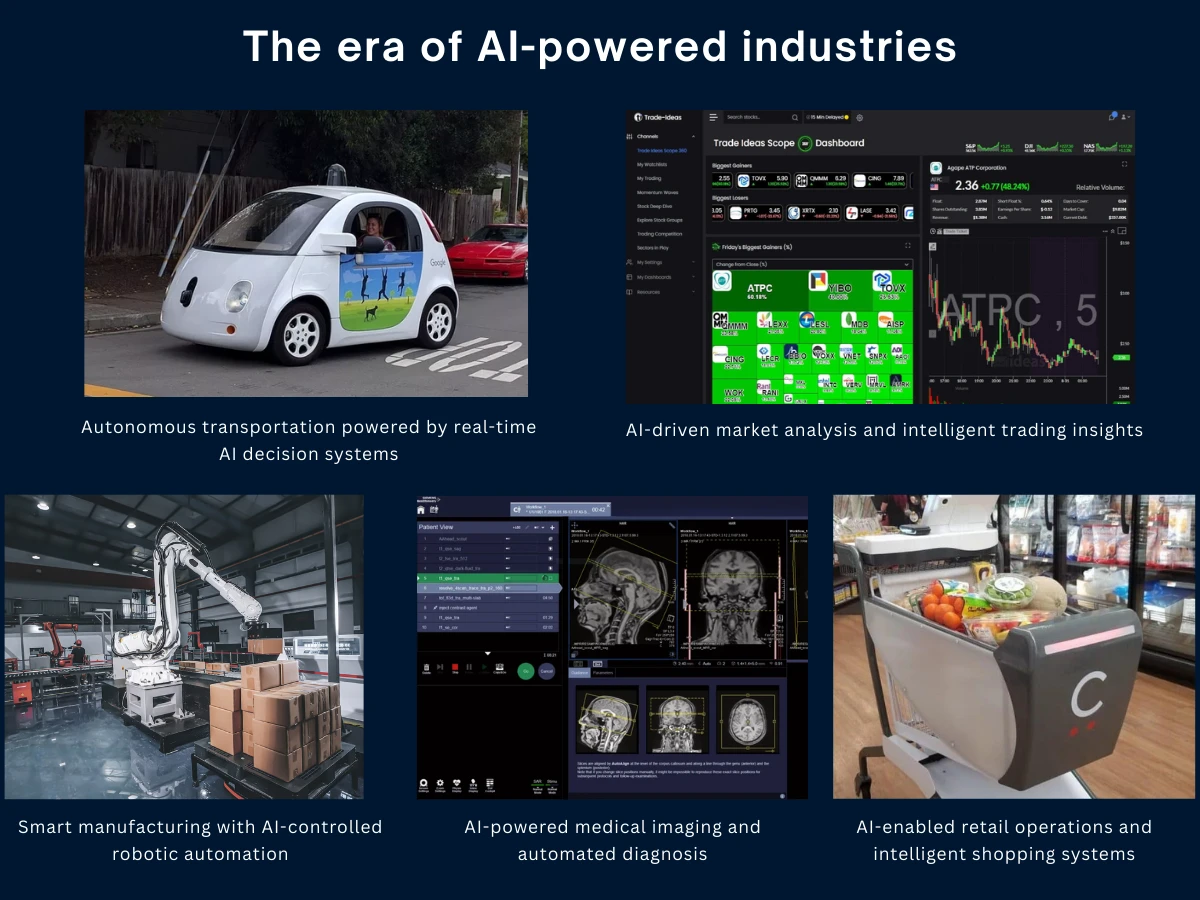
AI is actively transforming every major industry - from healthcare and finance to manufacturing and retail
The Industry Transformation Spectrum
Not all industries are adopting AI at the same pace. Understanding where your sector sits on the transformation spectrum is crucial for strategic planning and competitive positioning.
The companies that will thrive in the next decade are not necessarily those with the most advanced AI, but those that most effectively integrate AI into their core business processes to create real value.
Satya Nadella
CEO, Microsoft
AI Adoption Maturity Across Industries
From early experimental phases to full operational integration
Early Experimentation (Pilot stage, limited use cases)Full Integration (AI embedded in core operations)
1
2
3
4
5
6
7
1
Technology & Communications
85%
Leading with recommendation engines, content algorithms, and automated customer service
2
Financial Services
75%
Advanced fraud detection, algorithmic trading, and robo-advisors
3
Healthcare
70%
950+ FDA-approved AI medical devices, diagnostic imaging, and drug discovery
4
Manufacturing
65%
Predictive maintenance, quality control, and smart factory operations
5
Retail & E-Commerce
55%
Personalization engines, inventory optimization, and demand forecasting
6
Transportation
45%
Route optimization, autonomous vehicles testing, and fleet management
7
Education
25%
Early-stage adaptive learning and administrative automation
The Three Pillars of AI Business Value
Successful AI implementations deliver measurable impact across three fundamental dimensions. Understanding these pillars helps organizations prioritize investments and measure success.
The Three Pillars of AI Business Value
Click each pillar to explore real-world ROI examples and implementation metrics
Innovation Acceleration
ROI: 25-40%6-18 months
Enabling new products, services, and business models that weren't previously possible
Customer Experience Enhancement
ROI: 15-30%3-12 months
Personalizing interactions, improving response times, and anticipating customer needs
Operational Efficiency
ROI: 20-50%1-9 months
Automating routine tasks, reducing costs, and eliminating human error in repetitive processes
Combined Impact: Organizations implementing all three pillars report 50-80% overall productivity gains and 3-5x faster innovation cycles within 12-24 months.
Operational Efficiency: Automating routine tasks, reducing costs, and eliminating human error in repetitive processes
Innovation Acceleration: Enabling new products, services, and business models that weren't previously possible
Healthcare & Life Sciences: Saving Lives with Intelligence
Healthcare leads AI adoption with measurable patient outcomes and regulatory validation. As of August 2024, the FDA has authorized approximately 950 medical devices using AI or machine learning, with radiology and cardiology leading implementation.
Market Reality Check
The global AI in healthcare market reached $14.92 billion in 2024, with medical imaging accounting for 40% of applications. However, less than one-third of FDA-approved devices provide sex-specific data, highlighting implementation gaps.
Healthcare AI Evolution Timeline
From first FDA approval to $110B projected market - three decades of AI transforming healthcare diagnostics, treatment, and patient outcomes
1995Early FoundationsRegulatory Foundation
First FDA-Approved AI Medical Device
The FDA authorizes the first AI/ML-enabled medical device, marking the beginning of regulated AI in healthcare
IBM launches Watson for Oncology as commercial AI oncology tool, representing ambitious but challenging real-world deployment
2018-2020Exponential GrowthMainstream Adoption
FDA Approvals Accelerate Dramatically
AI medical device approvals surge from single digits to dozens annually, with radiology leading adoption at 76% of all approvals
2020-2021Pandemic ResponseCrisis Innovation
COVID-19 AI Diagnostic Surge
Pandemic drives rapid AI development for chest X-ray and CT analysis, achieving 95% sensitivity in COVID-19 detection
2022-2024Commercial MaturityMarket Maturation
Healthcare AI Market Reaches $26.6B
Global healthcare AI market grows 233% in 3 years, reaching $26.6B with 950 FDA-approved devices and 79% organizational adoption
2025-2030Future OutlookHealthcare Transformation
AI-First Healthcare Infrastructure
Market projected to reach $110.6B by 2030 with AI becoming standard infrastructure for diagnostics, drug discovery, and personalized medicine
Three Decades of Healthcare AI Evolution
950+
FDA-Approved AI Devices
$26.6B
Global Market Size (2024)
79%
Healthcare Organizations Using AI
$110.6B
Projected Market by 2030
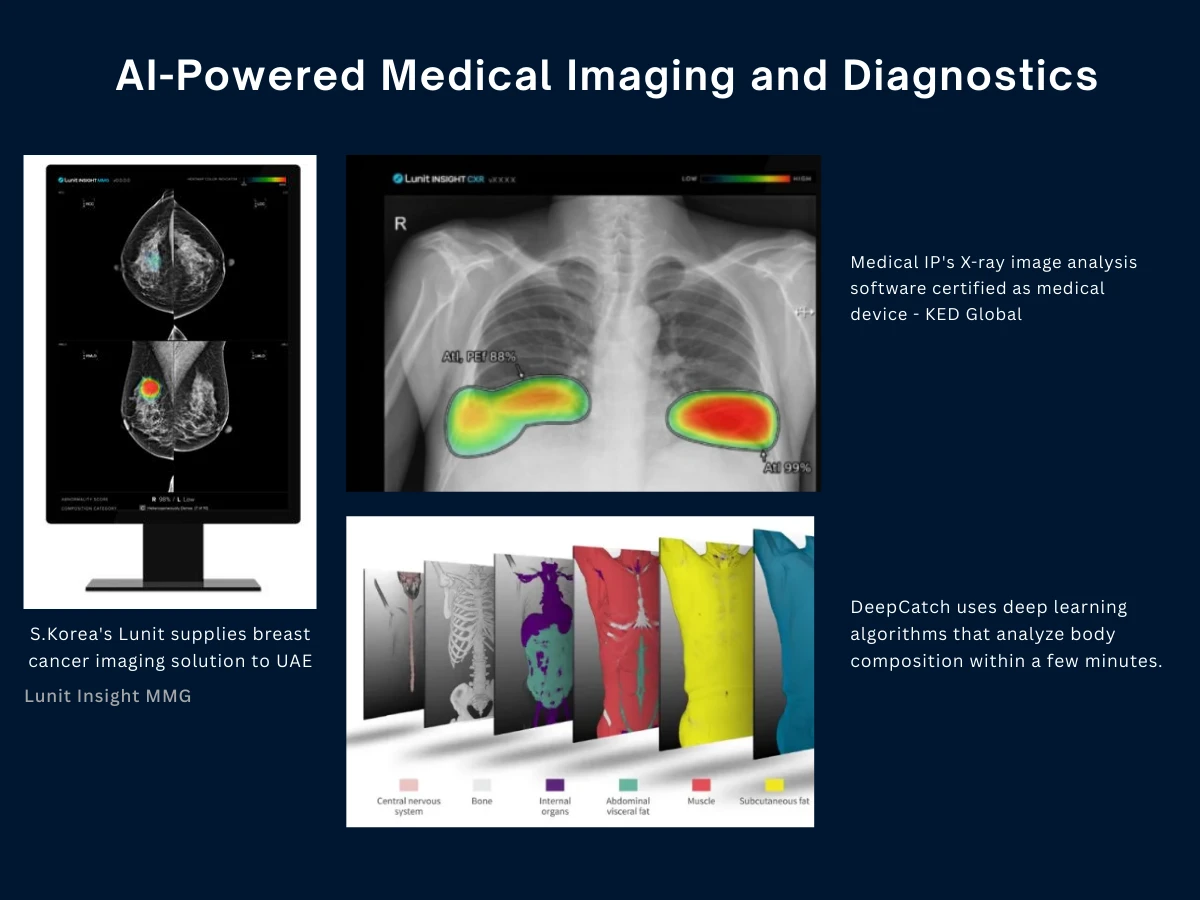
AI-enhanced diagnostic imaging helps radiologists detect conditions earlier and with greater accuracy
Medical Imaging and Diagnostics
AI-powered diagnostic imaging represents healthcare's most mature AI application, with proven accuracy improvements and workflow optimization. CT and MRI analysis dominate current deployments.
Radiology Enhancement: AI algorithms now match or exceed radiologists in detecting lung cancer, breast cancer, and diabetic retinopathy
Pathology Acceleration: Digital pathology AI reduces diagnosis time from days to hours while improving accuracy
Emergency Medicine: AI triage systems prioritize critical cases and reduce diagnostic delays in emergency departments
Real-World Impact: Paige's Virchow Foundation Model Study: Nature Medicine (2024) - clinical-grade computational pathology Scale: 1.5 million whole-slide images from 100,000 patients Result: Clinical-grade performance across 16 cancer types, including seven rare cancers Significance: State-of-the-art accuracy in AI-powered cancer detection
Drug Discovery and Development
AI is compressing drug development timelines from 10-15 years to potentially 3-5 years, with significant cost reductions in molecular design and clinical trial optimization.
Molecular Design: AI algorithms design novel drug compounds by predicting molecular behavior and interactions
Clinical Trial Optimization: Patient matching algorithms improve trial success rates and reduce recruitment time
Biomarker Discovery: Machine learning identifies genetic and molecular markers for personalized treatments
Regulatory Acceleration: AI assists in generating regulatory documentation and predicting approval likelihood
Financial Services: Intelligence Meets Capital
Financial services pioneered AI adoption with quantifiable risk reduction and revenue generation. The sector benefits from abundant historical data and clear success metrics, making AI ROI measurable and compelling.
Competitive Transformation
Leading financial institutions report 10-15% cost reductions and 20-30% improvement in fraud detection accuracy through AI implementation. The technology has moved from experimental to mission-critical infrastructure.
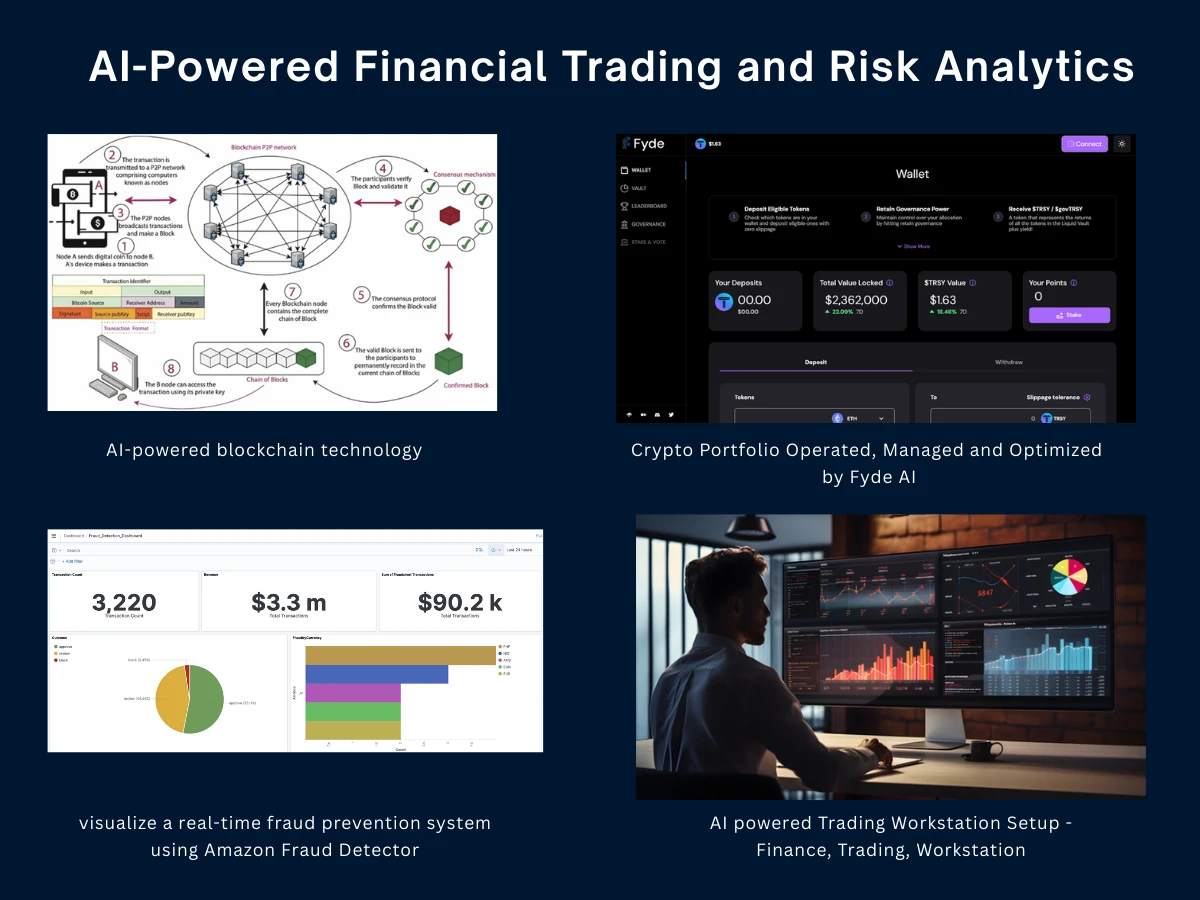
AI-driven trading systems and fraud detection platforms process millions of transactions in real time
Fraud Detection and Risk Management
Real-time fraud detection systems now process millions of transactions per second, using behavioral analysis and pattern recognition to identify threats before they cause damage.
Real-Time Analysis: Transaction monitoring systems detect fraud within milliseconds using behavioral patterns
Adaptive Learning: Models continuously update based on new fraud patterns and legitimate customer behavior
Cross-Channel Protection: Unified fraud detection across mobile, web, and physical payment channels
Real-World Impact: JP Morgan's COiN Platform What: Contract Intelligence platform using NLP and machine learning Scale: 12,000+ commercial credit agreements per year, 150 attributes per contract Result: Review time reduced from 360,000 hours annually to seconds Impact: Near-zero error rates, millions in cost savings, improved regulatory compliance Sources: ABA Journal, Harvard Business School Digital Initiative, CTO Magazine (2024-2025)
Algorithmic Trading and Portfolio Management
AI-powered trading systems now execute over 80% of equity trades, using advanced algorithms to analyze market data, news sentiment, and economic indicators in real-time.
High-Frequency Trading: Microsecond-level trading decisions based on market microstructure analysis
Sentiment Analysis: News and social media sentiment integration for market prediction
Risk Optimization: Portfolio construction algorithms balance return optimization with risk constraints
Market Making: Automated market-making systems provide liquidity and capture bid-ask spreads
Manufacturing & Industry 4.0: The Smart Factory Revolution
Manufacturing AI delivers measurable ROI through reduced downtime, improved quality, and operational cost savings. The global AI in manufacturing market reached $5.32 billion in 2024, projected to grow at 46.5% annually through 2030.
ROI Reality
Unplanned downtime costs manufacturers an average of $125,000 per hour, with automotive manufacturers facing costs up to $2.3 million per hour. AI-driven predictive maintenance reduces equipment downtime by up to 50% and maintenance costs by 30%, delivering clear financial impact.
Smart Factory AI Ecosystem
Integrated AI systems transforming manufacturing - from $119B market in 2024 to $249B by 2032, delivering 30-50% downtime reduction and 10-30% throughput gains
1
Layer 1: Data Foundation
IoT sensors and digital twins
IoT Sensor Network
Foundation layer collecting real-time data from equipment, environment, and production processes
84% of manufacturers implementing IoT sensor networks
Digital Twin Simulation
Virtual replica of physical factory enabling simulation, testing, and optimization before implementation
Market growing from $24.97B (2024) to $155.84B (2030)
2
Layer 2: AI Intelligence
Vision and predictive systems
Computer Vision QC
AI-powered visual inspection detecting defects and quality issues at production speed
63% of manufacturers using AI for quality control
Predictive Maintenance AI
Machine learning predicting equipment failures before they occur, preventing costly downtime
90% of machine manufacturers investing in predictive analytics
3
Layer 3: Operations
Production and supply chain
Production Optimization
AI continuously adjusting production parameters for maximum efficiency, quality, and throughput
78% of organizations using AI in at least one business function
Supply Chain Intelligence
End-to-end supply chain visibility and optimization from suppliers to customers
60% detect 200% more supply chain disruptions with AI
4
Layer 4: Optimization
Workforce and analytics
Workforce Augmentation
AI assistants and collaborative robots working alongside human workers to enhance productivity
85% believe smart manufacturing attracts new talent
Analytics & Insights
Real-time dashboards and AI-powered insights for data-driven decision making
92% believe smart manufacturing is key to competitiveness
Smart Factory Market Overview 2024
$119B
Smart Factory Market 2024
$25B
Digital Twin Market 2024
30-50%
Machine Downtime Reduction
92%
See AI as Competitive Driver
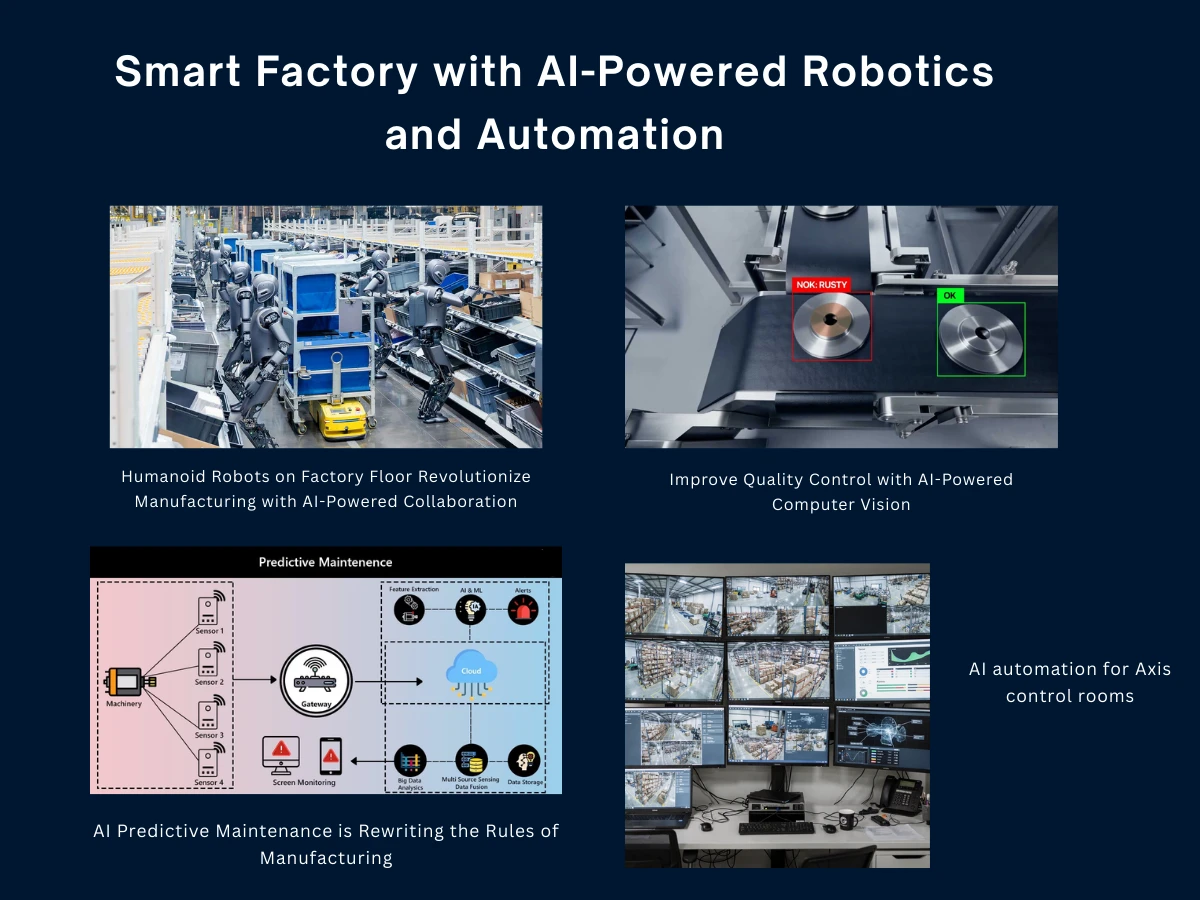
Smart factories combine AI, robotics, and computer vision to achieve unprecedented levels of efficiency and quality control
Predictive Maintenance and Quality Control
Predictive maintenance represents manufacturing AI's most successful application, with established ROI metrics and proven implementation frameworks across industries.
Equipment Health Monitoring: IoT sensors and ML algorithms predict equipment failures before they occur
Supply Chain Integration: Predictive models optimize parts inventory and maintenance resource allocation
Real-World Impact: Siemens MindSphere Predictive Maintenance What: AI-powered IoT platform using existing sensor infrastructure Detects: Fault patterns such as motor misalignment and bearing defects Result: Up to 50% reduction in unplanned downtime, 55% maintenance efficiency gain ROI: Customer payback achieved in less than three months Industry benchmark: U.S. DOE data shows 35-45% downtime reduction industry-wide Sources: Siemens Press Releases, Field Service Research, U.S. Department of Energy (2024-2025)
Smart Factory Management
Integrated AI systems orchestrate entire production facilities, optimizing resource utilization, energy consumption, and production throughput in real-time.
Production Optimization: AI algorithms adjust production parameters in real-time to maximize output and minimize waste
Energy Management: Smart energy systems reduce manufacturing energy costs by 15-25% through optimization
Robotic Coordination: AI orchestrates multiple robotic systems for flexible, adaptive manufacturing
Digital Twin Integration: Virtual factory models simulate and optimize production processes before implementation
Retail & E-Commerce: Personalizing Commerce at Scale
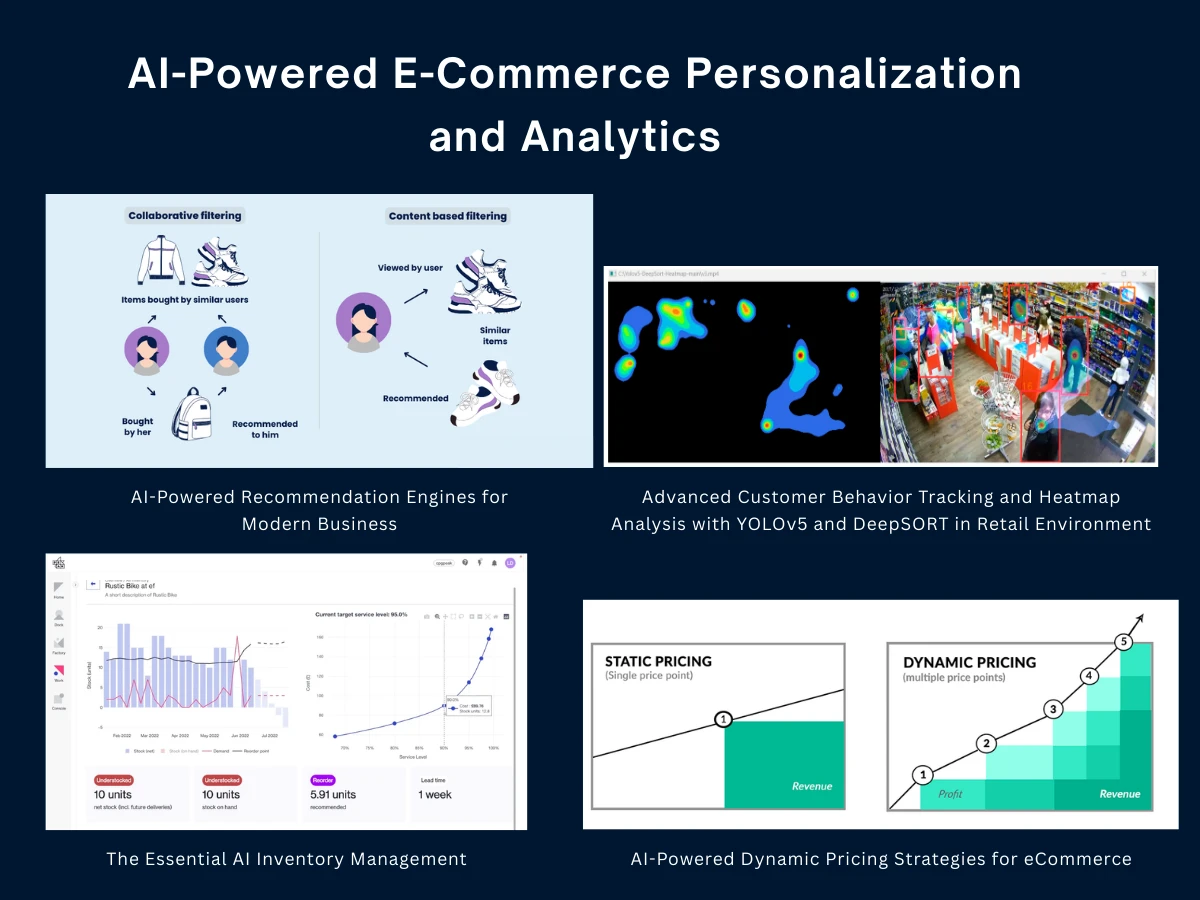
Retail AI focuses on customer personalization, inventory optimization, and demand forecasting. Leading e-commerce platforms attribute 35% of their revenue to AI-powered recommendation systems.
AI recommendation engines and dynamic pricing systems drive higher conversion rates and customer lifetime value
Recommendation Engines and Personalization
Sophisticated personalization engines analyze customer behavior, purchase history, and contextual data to deliver individualized shopping experiences that drive conversion and loyalty.
Product Recommendations: Collaborative filtering and deep learning models suggest relevant products with 25-35% conversion rates
Dynamic Pricing: Real-time pricing algorithms optimize prices based on demand, competition, and inventory levels
Customer Journey Optimization: AI personalizes website layouts, product placements, and marketing messages
Inventory Personalization: Location-specific inventory optimization based on local customer preferences
Real-World Impact: E-Commerce Recommendation Engines Amazon: 35% of purchases driven by AI recommendations, processing billions of data points Netflix: 75% of viewership from recommendations, saving $1B+ annually in reduced churn Independent finding: University of Florida (2018) controlled study measured 11% sales boost - suggesting true impact may be more modest than industry estimates Sources: McKinsey (2013), University of Florida (2018), Stratoflow, Factspan (2024-2025)
Inventory and Demand Forecasting
AI-powered demand forecasting reduces inventory costs while improving product availability, using external data sources like weather, events, and economic indicators.
Multi-Variable Forecasting: Algorithms incorporate weather, seasonality, promotions, and market trends
Supply Chain Optimization: End-to-end supply chain visibility and automated reordering systems
Markdown Optimization: AI determines optimal timing and pricing for clearance merchandise
New Product Introduction: Predictive models estimate demand for new products with limited historical data
Transportation & Logistics: Moving Intelligence
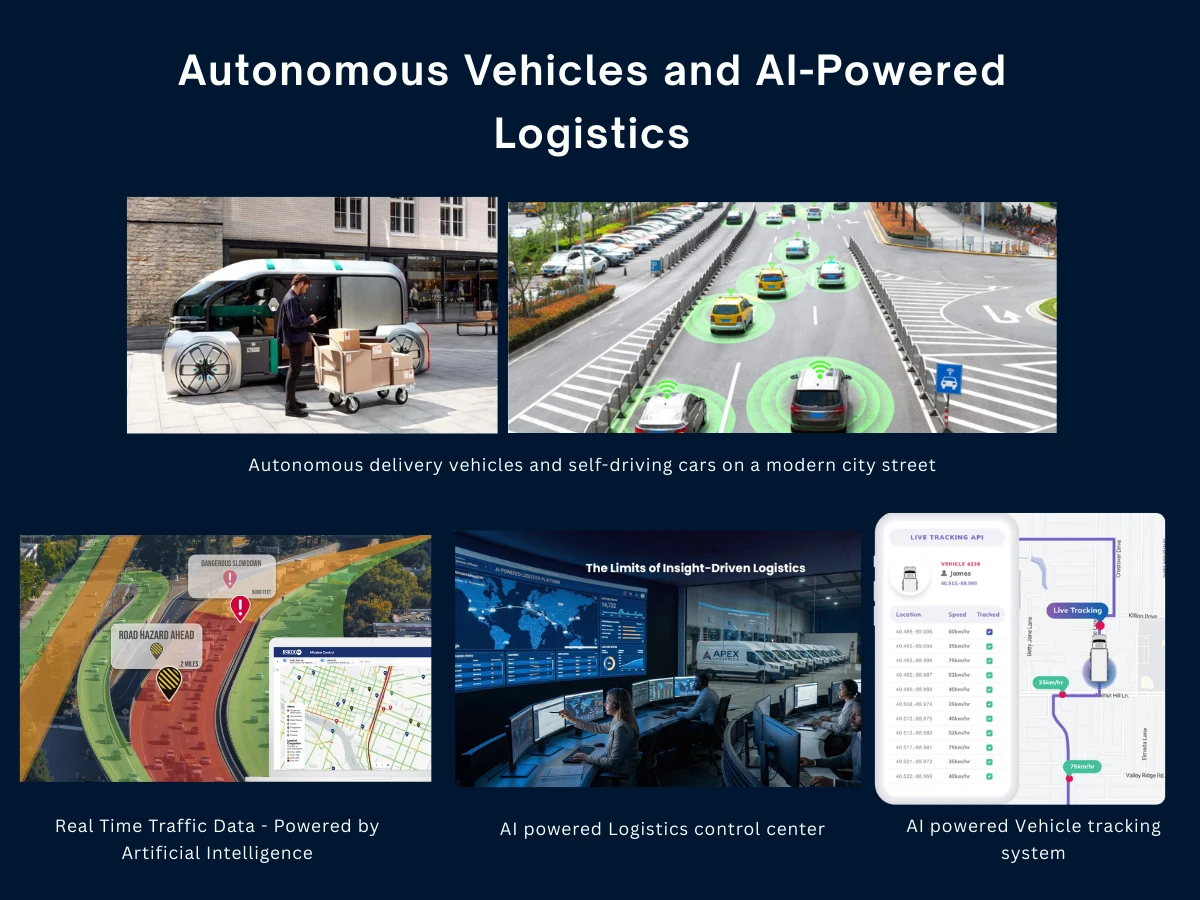
Transportation AI optimizes routes, manages fleets, and enables autonomous systems. While full autonomy remains developmental, operational AI applications deliver immediate value through efficiency gains.
AI-powered route optimization and autonomous vehicle systems are reshaping how goods and people move around the world
Route Optimization and Fleet Management
AI-powered logistics systems reduce delivery times, fuel consumption, and operational costs through intelligent routing and resource allocation.
Dynamic Routing: Real-time traffic, weather, and delivery constraint integration for optimal routes
Fleet Utilization: Vehicle and driver assignment algorithms maximize resource utilization
Last-Mile Optimization: AI solves the complex last-mile delivery challenge with drone and autonomous vehicle integration
Real-World Impact: Waymo's Autonomous Vehicle Safety Record Scale: 56.7 million fully autonomous miles (100M total as of July 2024) Safety: 88% fewer property damage claims, 92% fewer bodily injury claims (Swiss Re) Crash data: 84% fewer airbag deployments, 73% fewer injury crashes, 48% fewer police reports Operations: 450,000+ trips per week across Phoenix, San Francisco, Los Angeles, and Austin Sources: Waymo Safety Impact Report, Swiss Re Study, TechCrunch, CNBC (2024-2025)
Technology & Communications: The AI-First Infrastructure
Technology companies lead AI adoption with 78% of organizations now using AI in at least one business function. The sector focuses on content algorithms, user experience optimization, and infrastructure automation.
Content Recommendation and Curation
Sophisticated content algorithms drive engagement and revenue for digital platforms, processing petabytes of user behavior data to deliver personalized experiences at global scale.
Content Discovery: Advanced recommendation algorithms help users find relevant content across vast digital libraries
Feed Optimization: Social media algorithms optimize content ordering for maximum user engagement
Search Enhancement: AI improves search relevance and introduces conversational search capabilities
Content Moderation: Automated systems detect and remove harmful content while preserving legitimate expression
Cross-Industry ROI Analysis
Different industries realize AI value through distinct metrics and timelines. Understanding these patterns helps organizations set realistic expectations and benchmark performance.
Cross-industry AI implementation patterns showing value drivers, timelines, and key success metrics based on organizational adoption data
Industry
Primary Value Driver
Typical ROI Timeframe
Implementation Complexity
Success Metric
Healthcare
Diagnostic Accuracy
6-12 months
High
Patient Outcomes
Financial Services
Risk Reduction
3-6 months
Medium
Cost Savings
Manufacturing
Operational Efficiency
3-9 months
Medium
Uptime/Quality
Retail
Customer Personalization
1-3 months
Low
Revenue Growth
Transportation
Route Optimization
1-6 months
Medium
Cost Reduction
Technology
User Engagement
1-2 months
Low
Platform Metrics
Source: Analysis based on McKinsey Global Institute (2024) 'The State of AI' and PwC (2024) 'AI Jobs Barometer' industry implementation surveys
Strategic Implementation Framework
Successful AI implementation follows proven patterns across industries. Organizations that follow structured approaches achieve measurable results faster and with lower risk.
AI Readiness Assessment
Before investing in AI solutions, organizations must honestly assess their data maturity, technical capabilities, and organizational readiness for change.
Data Infrastructure: Evaluate data quality, accessibility, and governance practices across the organization
Technical Capabilities: Assess current IT infrastructure, cloud readiness, and integration capabilities
Talent and Skills: Inventory existing AI/ML expertise and identify training or hiring needs
Change Management: Evaluate organizational culture and readiness for AI-driven process changes
Budget and Timeline: Establish realistic investment expectations and implementation timelines
Regulatory Compliance: Understand industry-specific AI regulations and compliance requirements
Phased Implementation Strategy
Successful organizations start with high-impact, low-risk use cases and gradually expand AI capabilities across the enterprise. This approach builds expertise and confidence while delivering early wins.
Pilot Projects: Select 2-3 well-defined use cases with clear success metrics and limited scope
Data Foundation: Establish data pipelines, quality standards, and governance frameworks
Proof of Value: Demonstrate measurable business impact before scaling investment
Capability Building: Develop internal expertise through training, hiring, and vendor partnerships
Scale and Integrate: Expand successful pilots and integrate AI into core business processes
Continuous Innovation: Establish ongoing AI research and development capabilities
The Next Wave: Emerging Applications and Trends
As AI capabilities advance and costs decrease, new applications emerge across industries. Understanding these trends helps organizations prepare for the next phase of AI-driven transformation.
Investment Momentum
92% of companies plan to increase AI investments over the next three years, with 49% of technology leaders reporting AI is "fully integrated" into their core business strategy. The transformation is accelerating, not slowing down.
Global AI Investment & Market Trends
From $391B in 2024 to $1.81T by 2030 - capital flows, sector breakdowns, and investment trends reshaping the global AI landscape
2024 Global Investment Snapshot
$391B
Total AI Market 2024
$100B+
VC Funding (+80% YoY)
37%
Of All Venture Funding
78%
Enterprise AI Adoption
Overall AI Market
$391B$1.81T by 2030
29.2% CAGR
Total global AI market encompassing all sectors, applications, and investment types from infrastructure to applications
78% of organizations using AI in 2024
Generative AI
$45B$110B by 2030
40.1% CAGR
Fastest-growing AI segment focused on content generation, code assistance, and creative applications
71% of organizations regularly using Gen AI
Healthcare AI
$6.9B$188B by 2030
37.5% CAGR
Medical diagnostics, drug discovery, clinical decision support, and healthcare operations optimization
79% of healthcare orgs using AI technology
Financial Services AI
$17B$70.1B by 2033
16.5% CAGR
Fraud detection, algorithmic trading, risk management, and automated customer service for financial institutions
75% of financial services using AI (2nd highest)
Enterprise AI Applications
$13.8B$80B+ by 2028
42% CAGR
Productivity tools, automation platforms, customer service, and operational intelligence for enterprises
78% of enterprises using AI, only 26% scaling value
AI Infrastructure & Compute
$200B$1T+ by 2027
50% CAGR
Data centers, GPUs, cloud infrastructure, and compute resources powering AI model training and deployment
100% of major cloud providers investing heavily
2030 Market Outlook
$1.81T
Total AI Market
$1.3T
Gen AI Economic Impact (Annual)
29.2%
Average Annual Growth
4.6x
Market Growth Multiple
Key Trends Shaping the Future
Multimodal AI Integration: Systems that process text, images, audio, and sensor data simultaneously for richer insights
Edge AI Deployment: Moving intelligence closer to data sources for real-time processing and privacy protection
Industry-Specific Models: Purpose-built AI models trained on sector-specific data and use cases
Autonomous Systems: Fully automated processes that operate with minimal human oversight
AI-Human Collaboration: Augmented intelligence systems that enhance rather than replace human capabilities
Regulatory AI: Compliance-focused AI systems that ensure regulatory adherence and risk management
Executive Action Plan
Business leaders must take deliberate action to capture AI value while managing risks. Success requires strategic thinking, tactical execution, and organizational commitment.
Develop AI Literacy: Leaders must understand AI capabilities, limitations, and business implications
Invest in Data Infrastructure: Quality data is the foundation of successful AI implementation
Build or Partner for Talent: Secure AI expertise through hiring, training, or strategic partnerships
Start with Clear Use Cases: Focus on specific business problems where AI can deliver measurable value
Embrace Experimentation: Create safe environments for AI pilot projects and rapid iteration
Plan for Change Management: Prepare the organization for AI-driven process and role changes
From Potential to Performance
The AI revolution isn't coming—it's here, delivering measurable business value across industries. While the $4.4 trillion economic potential remains largely untapped, early movers are establishing competitive advantages through strategic AI implementation.
Success requires moving beyond AI hype to focus on specific business problems, measurable outcomes, and organizational readiness. The companies that master this balance will define the next decade of business innovation.
The Competitive Imperative
AI adoption is no longer optional—it's a competitive necessity. Organizations that delay implementation risk being disrupted by AI-native competitors who build intelligent capabilities into their core operations from the ground up.
Continue Your AI Journey
Now that you understand how AI is transforming industries today, explore what the future holds. Discover emerging trends, technological breakthroughs, and how to prepare for the next wave of AI innovation.
McKinsey Global Institute"State of AI in Operations 2025"(January 2025)
Survey of global executives revealing 92% of companies plan to increase AI investments over the next three years, with findings on AI maturity and leadership barriers
Swiss Re & Waymo"Do Autonomous Vehicles Outperform Latest-Generation Human-Driven Vehicles? A Comparison to Waymo's Auto Liability Insurance Claims at 25 Million Miles"(December 2024)
Study analyzing 25.3 million autonomous miles showing 88% reduction in property damage claims and 92% reduction in bodily injury claims compared to human drivers