Understanding artificial intelligence and machine learning through clear explanations and practical examples
Read 15 min
AI Fundamentals Machine Learning Getting Started Tutorial
Artificial intelligence powers everything from voice assistants and medical diagnostics to self-driving cars and language translation - yet most people can't explain what it actually is. This guide breaks down AI and machine learning into clear, practical concepts that anyone can understand, regardless of technical background.
Abbreviations Used in This Article
AIArtificial Intelligence
MLMachine Learning
DLDeep Learning
GPUGraphics Processing Unit
EUEuropean Union
What We Have in This Page
01
What is Artificial Intelligence - Clear definitions and how AI actually works fundamentally
02
Machine Learning Fundamentals - The engine behind modern AI and three ways computers learn
03
AI Family Tree Explained - How AI, Machine Learning, and Deep Learning fit together
04
AI in Real Life - Industry applications and impact across healthcare, finance, and more
05
Generative AI - ChatGPT Era - How AI creates content: text, images, music, and code
06
Why Understanding AI Matters - Importance for career and decision-making
07
Common Misconceptions Clarified - Separating AI reality from hype and fears
08
New AI Career Opportunities - Real jobs being created by AI revolution (2023-2025)
09
AI Ethics & Bias - Why AI can be unfair and what we're doing about it
10
AI Challenges & Limitations - What AI can't do and real-world constraints
11
Essential AI Knowledge - Key takeaways from this tutorial
12
Your Learning Path Forward - Next steps and tutorial series roadmap
What is Artificial Intelligence?
Definition
Artificial Intelligence
Artificial intelligence means making computers smart enough to do things that normally need a human brain - like recognizing faces, understanding speech, or making decisions.
Imagine teaching a computer to be smart like a person. That's exactly what AI does. When you talk to Siri, she understands your words. When you upload a photo and Facebook suggests tagging your friends, it recognizes their faces. When your bank texts you about suspicious spending, AI spotted something unusual. These computers learned to be smart by looking at millions of examples.
Simple AI Example
Gmail looks at every email that comes to you and decides "This is good" or "This is spam." It learned this by looking at billions of emails. Now it can spot spam instantly - something that would take a human forever to do.
How AI Actually Works
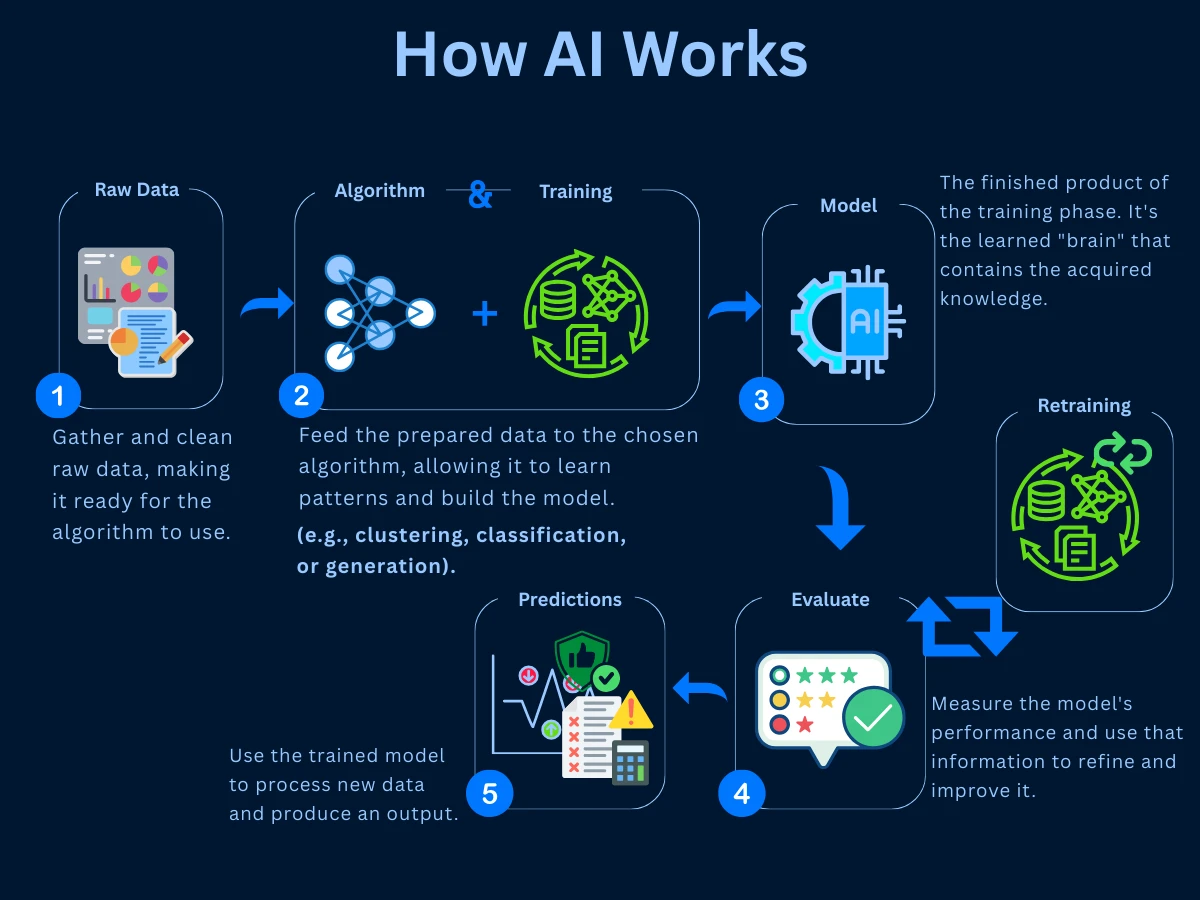
Old computer programs worked like following a recipe: "Step 1: do this, Step 2: do that." AI is completely different. Instead of giving the computer a recipe, we show it thousands of examples and let it figure out the pattern by itself.
Think about how you learned to recognize dogs. Nobody gave you a list of rules like "Dogs have four legs and bark." Instead, people showed you many dogs and said "That's a dog" until you figured it out. AI learns the exact same way - by looking at tons of examples until it understands the pattern.
How AI learns by recognizing patterns in data, similar to how humans learn from examples
Machine Learning: The Engine of Modern AI
Definition
Machine Learning
Machine learning is when computers learn to do tasks by studying examples, just like how you learned to ride a bike by practicing - not by memorizing rules.
Here's the big difference: Instead of telling a computer exactly what to do, we show it thousands of examples and let it learn the pattern. It's like teaching a child - you don't give them a rulebook, you show them examples until they understand.
Think about email spam. The old way: Write rules like "If email says 'FREE MONEY', it's spam." But spammers got sneaky and wrote "F-R-E-E M0NEY" instead. The new way: Show the computer a million spam emails and a million good emails. Now it can spot spam even when spammers try new tricks, because it understands the deeper patterns.
Three Ways Computers Learn
Just like people learn in different ways, computers can learn in three main ways. Each way works best for different kinds of problems.
Supervised Learning: Learning with a teacher - like studying flashcards with answers on the back. Example: Email spam detection learns from millions of labeled emails to identify spam automatically.
Unsupervised Learning: Finding patterns yourself - like sorting mixed LEGO bricks by color without instructions. Example: Netflix discovering viewer groups automatically to recommend content.
Reinforcement Learning: Learning through trial and error - like practicing chess until you win. Example: AlphaGo learning Go strategy by playing millions of games against itself.
These three approaches power different AI applications. Want to understand when to use each one and how they actually work? Continue to our Machine Learning Fundamentals tutorial for the complete explanation.
The three main approaches to machine learning: supervised, unsupervised, and reinforcement learning
The AI Family Tree - Simple Version
Think of AI like a big family tree. Here's how it all fits together:
Visual representation of how AI, ML, and DL relate to each other in a nested hierarchy
Why This Visual? This nested view reveals the containment hierarchy that text alone can't show clearly—AI contains ML, ML contains DL, and all power different applications. Understanding these relationships helps you grasp why "AI", "Machine Learning", and "Deep Learning" aren't interchangeable terms.
AI Family Tree At-a-Glance
78%
Organizations Using AI
72%
Deploying Machine Learning
71%
Using Deep Learning (Gen AI)
4
Primary Application Areas
The AI Family Tree
Understanding the nested relationship: AI (the big umbrella) contains Machine Learning (learning from data), which contains Deep Learning (neural networks)
Artificial Intelligence
Level 1 - Broadest
The broadest category - any computer system that exhibits intelligent behavior, from simple rule-based programs to advanced neural networks
78% of organizations using AI in at least one function
Artificial Intelligence: The biggest box - any computer that acts smart
Machine Learning: Smaller box inside AI - computers that learn from examples
Deep Learning: Smallest box inside ML - computers with brain-like networks
Computer Vision: AI that can "see" and understand images
Natural Language: AI that can understand and speak like humans
AI vs Machine Learning vs Deep Learning Comparison
Aspect
Artificial Intelligence
Machine Learning
Deep Learning
Definition
Systems exhibiting intelligent behavior
Systems that learn from data patterns
Multi-layered neural networks
Historical Origin
1950s - programmed intelligence
1980s - statistical learning
2010s - neural network renaissance
Data Requirements
Varies by approach
Moderate structured datasets
Large-scale datasets (millions of examples)
Computational Needs
Low to high
Moderate processing power
High-performance GPUs required
Human Involvement
High (rule programming)
Medium (feature engineering)
Low (automatic feature discovery)
Problem Complexity
Simple to complex
Moderate complexity
Highly complex patterns
Common Applications
Rule-based chatbots, game AI
Recommendation systems, fraud detection
Image recognition, language translation
Transparency
Highly interpretable
Moderately interpretable
Often "black box"
Source: Based on academic literature and industry implementation studies (MIT, Stanford, and major tech companies, 2020-2024)
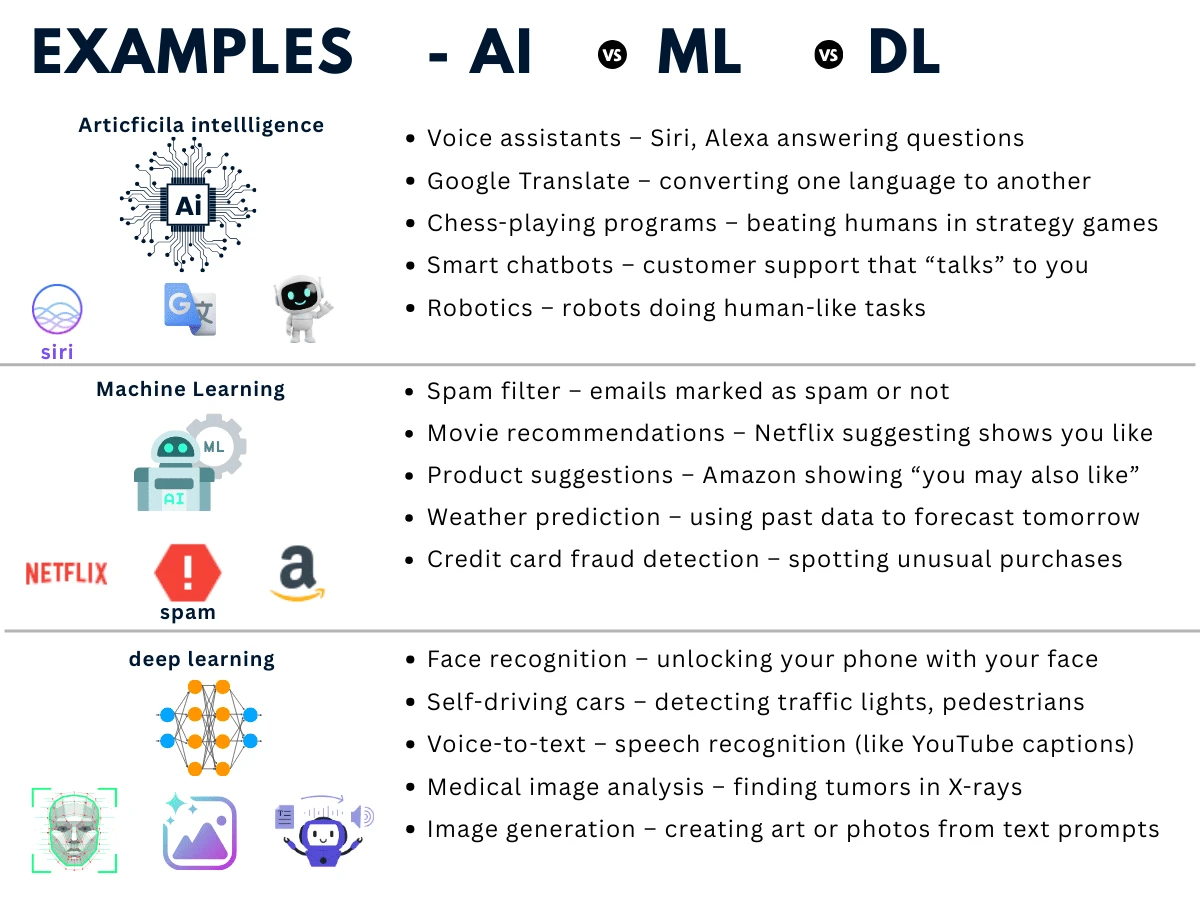
Practical examples showing how AI, ML, and DL differ in real-world applications
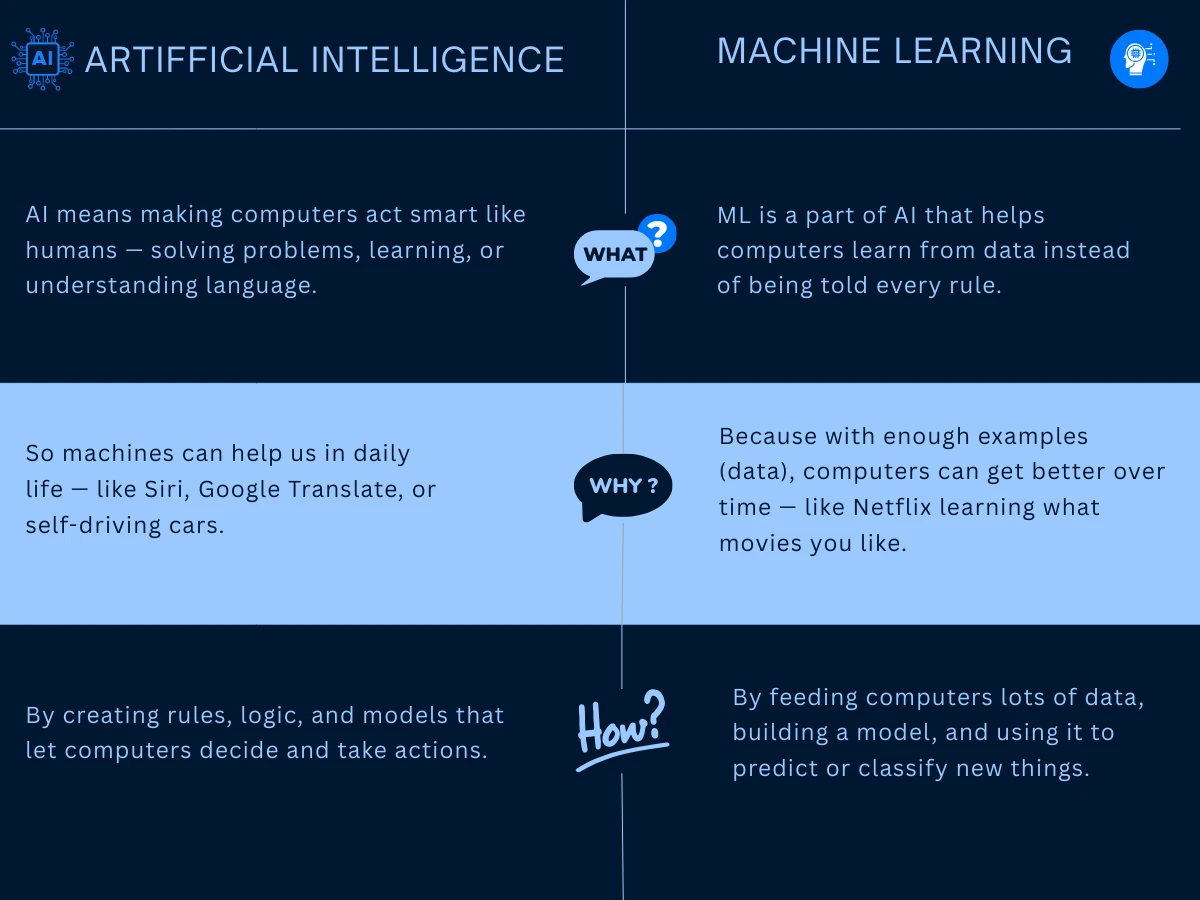
Detailed comparison of AI and ML characteristics, capabilities, and use cases
The Simple Summary
AI is the broad idea of giving machines the ability to act intelligently. Machine Learning is the practical approach that uses algorithms to learn from data and improve over time. Deep Learning takes it further by using neural networks to understand complex data like images, videos, and text.
Where You See AI in Real Life
AI isn't just in science fiction movies - it's everywhere around you right now. From the moment you wake up to when you go to sleep, you're probably using AI dozens of times without even knowing it.
Here are the biggest ways AI is changing the world, explained in simple terms:
Industry
AI Applications
Business Impact
Example Companies
Healthcare
Medical imaging analysis, drug discovery, treatment recommendations
Crop monitoring, pest detection, yield optimization
15-20% yield increase, 30% pesticide reduction
John Deere, Climate Corp
Source: Based on industry reports from McKinsey Global Institute, Accenture, and company-published case studies (2022-2024)
Healthcare
AI analyzes medical scans faster than radiologists, discovers new drugs in months not years, and predicts health risks before symptoms appear.
Transportation
Self-driving cars process sensor data 60 times per second, delivery drones optimize routes automatically, and traffic systems reduce congestion by 30%.
Finance
AI detects fraudulent transactions in milliseconds, powers algorithmic trading handling 70% of trades, and assesses loan risks with 95% accuracy.
E-Commerce
AI personalizes shopping experiences for 2.8B users, optimizes inventory to reduce waste by 40%, and powers voice shopping assistants.
Manufacturing
AI predicts equipment failures 3 weeks in advance, optimizes production lines for 20% efficiency gains, and ensures quality control with computer vision.
Entertainment
AI creates movie recommendations for 230M Netflix users, generates realistic video game worlds, and composes music that tops charts.
Generative AI - The ChatGPT Revolution
In 2022, ChatGPT changed everything. Suddenly, AI could write essays, create images, and hold conversations. This is "Generative AI" - AI that creates new things instead of just analyzing existing stuff.
What Makes Generative AI Different?
Traditional AI analyzes and categorizes (like spam filters sorting emails). Generative AI creates brand new content - writing stories, drawing pictures, composing music, even generating computer code. It's like the difference between a critic and an artist.
How Generative AI Actually Works: Think of it like teaching a student. First, the AI reads millions of examples (books, images, code). Then, it learns the patterns and rules. Finally, when you give it a prompt like "Write a poem about cats," it generates something new based on what it learned - but it's creating, not copying.
ChatGPT & Claude: AI that writes, answers questions, and helps with tasks by generating text responses
DALL-E & Midjourney: AI that creates original images from text descriptions like 'a cat riding a skateboard in space'
GitHub Copilot: AI that writes computer code by understanding what programmers are trying to build
Suno & Udio: AI that composes original music in any style you describe
RunwayML: AI that generates and edits videos from text prompts
The Speed of Change
ChatGPT gained 100 million users in just 2 months - faster than any technology in history. Instagram took 2.5 years to reach that milestone. This shows how quickly generative AI is becoming part of everyday life.
Generative AI uses Deep Learning (those neural networks we talked about earlier) with billions of parameters. It doesn't truly "understand" like humans do - it's really good at recognizing patterns and generating content that looks like it understands. But the results are so impressive that it's transforming how we work, create, and learn.
Why Everyone Should Understand AI
AI isn't going away - it's becoming a bigger part of life every single day. Understanding the basics helps you make better decisions, whether you're choosing a career, running a business, or just trying to understand what's happening in the world.
Now you know the key ideas: computers can learn from examples, AI is already everywhere around you, and it's changing every industry. This knowledge helps you understand news stories about AI, make smart choices about AI tools, and spot the difference between real AI advances and just hype.
Common AI Misconceptions Clarified
AI is just fancy programming: Wrong! AI figures out things on its own that no human programmed. It discovers patterns we never taught it.
AI will take everyone's jobs: Actually, AI is creating entirely new career categories that didn't exist 5 years ago. While some tasks get automated, new roles emerge faster than old ones disappear.
AI is either perfect or useless: Nope! Most AI is very good but not perfect. It makes mistakes, just like humans do. The key is knowing when to trust it and when to double-check.
AI thinks and feels like people: Not at all. AI processes information completely differently from humans. It has no emotions, consciousness, or real understanding - it just follows patterns.
Only computer experts can use AI: False! Doctors, teachers, business owners, and people in all kinds of jobs are now using AI tools without being programmers.
New Career Opportunities Created by AI
The Job Creation Reality
Companies are actively hiring for roles that didn't exist in 2020. These aren't future predictions - these jobs are posted on LinkedIn, Indeed, and company career pages right now with competitive salaries.
While AI automates some tasks, it simultaneously creates entirely new job categories. Every major technology shift follows this pattern - cars replaced horse carriage drivers but created millions of automotive jobs. AI is no different.
Real AI Jobs Companies Are Hiring Today (2023-2025)
Role
What They Do
Who Hires
Entry Barrier
Prompt Engineer
Design effective AI instructions and workflows
OpenAI, Anthropic, Google, Klarna
Medium
AI Content Creator
Produce AI-assisted videos, graphics, marketing
YouTube, TikTok, Marketing Agencies
Low
AI Product Manager
Lead AI product development and strategy
Tech companies, Startups
High
LLM Application Developer
Build apps using ChatGPT/Claude APIs
Most tech companies
Medium
AI Integration Engineer
Connect AI systems to existing software
Enterprises, SaaS companies
Medium
AI Ethics Specialist
Ensure responsible AI development
Meta, Microsoft, Amazon, Governments
High
AI QA Tester
Test AI reliability and catch errors
AI companies, Tech firms
Low
RLHF Annotator
Train AI through feedback (post-ChatGPT boom)
OpenAI, Anthropic, Scale AI
Low
AI Literacy Trainer
Teach AI skills to teams and students
Schools, Universities, Corporations
Medium
AI Automation Specialist
Automate business workflows with AI
Consulting firms, Enterprises
Medium
Synthetic Media Producer
Create AI-generated ads and content
Advertising agencies
Low
AI Compliance Officer
Navigate AI regulations (EU AI Act)
Large corporations, Government
High
Source: Job market analysis based on LinkedIn, Indeed, and company career pages for OpenAI, Anthropic, Google, Meta, Microsoft, and leading AI companies (2023-2025)
These represent just the established roles. Emerging positions like AI Agent Builder, AI Workflow Architect, and Synthetic Data Engineer are appearing in job listings as the field evolves. The pattern is clear: understanding AI opens more career doors than it closes.
AI Ethics & Bias - Why It Matters
AI learns from human data, which means it can accidentally learn our biases too. This isn't science fiction - it's happening right now and affecting real people's lives.
Real-World Example
Amazon built an AI hiring tool to review job applications. The AI learned from 10 years of mostly male employees, so it started automatically rejecting resumes from women. Amazon had to shut it down. This shows how AI can amplify existing unfairness if we're not careful.
Why AI Gets Biased: Remember how AI learns from examples? If those examples contain human prejudices (like racial bias, gender stereotypes, or age discrimination), the AI learns those patterns too. It's not malicious - the AI doesn't "know" it's being unfair. It just sees patterns in the data.
Facial Recognition Bias: Studies show some facial recognition systems are less accurate for people with darker skin, because they were trained mostly on lighter-skinned faces
Loan Approval Bias: Some AI lending systems deny loans to qualified applicants from certain neighborhoods, repeating historical discrimination patterns
Healthcare Bias: Medical AI trained mostly on data from one demographic group may give worse recommendations for others
Criminal Justice Bias: Risk assessment AI used in courts has been shown to predict higher risk for some racial groups, even with similar criminal histories
What Companies Are Doing About It
Leading tech companies now have "AI Ethics" teams that test for bias before deploying AI. They use diverse training data, audit AI decisions, and allow humans to override AI recommendations. Some countries are creating laws requiring AI transparency and fairness testing.
The good news: we're aware of these problems and actively working on solutions. Responsible AI development includes diverse training data, regular bias testing, human oversight, and transparency about how AI makes decisions. When you hear about "Responsible AI" or "Ethical AI," this is what it means.
AI Challenges & Real Limitations
AI is powerful, but it's not magic. Understanding what AI can't do is just as important as understanding what it can do.
AI Needs Huge Amounts of Data: Training GPT-4 required reading basically the entire internet. For tasks with limited examples, AI struggles. You can't train an AI to diagnose a rare disease if only 100 cases exist worldwide.
AI Makes Confident Mistakes: ChatGPT will sometimes make up facts with complete confidence (called 'hallucinations'). It can write a convincing essay with totally false information. Always verify important AI-generated content.
AI Needs Massive Computing Power: Training advanced AI models costs millions of dollars in electricity and specialized computers. This puts cutting-edge AI out of reach for small companies and researchers.
AI Can't Explain Its Thinking: Deep Learning models make decisions using billions of parameters. Even the engineers who built them can't always explain why an AI made a specific choice. This is the 'black box' problem.
AI Lacks Common Sense: AI can beat world champions at chess but can't understand that you can't fit an elephant in a car. It knows patterns but doesn't understand the physical world like humans do.
AI Can Be Fooled Easily: Add invisible noise to an image and AI might think a panda is a gibbon. Change one word in a sentence and AI sentiment analysis completely flips. These 'adversarial attacks' show AI fragility.
The Cost Reality
Training GPT-3 cost an estimated $4.6 million in computing resources. Running ChatGPT costs OpenAI roughly $700,000 per day. This is why most AI services charge fees or show ads - AI is expensive to operate at scale.
These limitations don't mean AI isn't valuable - they mean AI works best when combined with human judgment. The most successful companies use AI to handle routine tasks while humans make final decisions on complex or sensitive matters. AI is a powerful tool, not a replacement for human thinking.
Essential AI Knowledge for the Modern World
AI is Really Good at Finding Patterns: AI can spot patterns in huge amounts of data that would take humans forever to find
Most AI Today Learns from Examples: Instead of following pre-written rules, most modern AI learns by looking at thousands or millions of examples
Good Data = Good AI: AI is only as smart as the examples you show it. Bad examples = bad AI. Good examples = good AI
AI Works Best with Humans: The most successful AI doesn't replace people - it helps them make better decisions faster
Every Business is Using AI Now: From hospitals to banks to stores, every industry is using AI to work better and faster
Your AI Learning Path Forward
This tutorial series continues with specialized topics covering machine learning algorithms, mathematical foundations, programming implementation, and industry applications. Use the sidebar navigation to explore the complete learning path at your own pace.
Continue Your AI Journey
Now that you understand AI fundamentals, explore how AI evolved from 1950s theoretical concepts to today's revolutionary applications. The next tutorial examines key milestones, breakthrough moments, and the people who shaped artificial intelligence into the transformative technology we see today.

.C2FQmf4a_1coaKb.webp)
.rwqYgF42_ES4ie.webp)